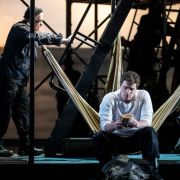
With this new production of Billy Budd for its annual festival, the Opéra national de Lyon fills a gap in its repertoire: it has never before staged Benjamin Britten’s opera – which, it has to be said, remains something of a rarity in France; it was only in 1996, in a striking production by Francesca Zambello at the Opéra de Paris, that it received its first performance in the country.

Bearing in mind that Billy Budd largely remains a novelty in France, Richard Brunel – a director sometimes prone to more radical reinterpretation – here opts for clarity and coherence. He remains almost entirely true to the libretto that Edward Morgan Forster and Eric Crozier adapted from Herman Melville’s novel, and the staging gives a clear account of the tragic story of Billy Budd, a young sailor press-ganged into service on a British warship in the 1790s. While his extraordinary beauty exercises a fascination on the crew, it also arouses jealousy that alienates him and leads to his demise.
One of Brunel’s departures from the text is to set the action in the 20th century, but ultimately this is neither here nor there. There is some historical dislocation – diluting the power of references to the possible influence on the British of French revolutionary ideas, and demanding suspension of disbelief when it came to a wartime clash between the British and French navies in the 20th century – but, overall, the intelligibility of the action remains intact, as do the dramatic and moral dynamics of the libretto.

The other liberty Brunel takes reinforces the brutality of the denouement: rather than being hanged, Billy is stabbed by one of Vere’s officers. This heightens the dramatic tension and, specifically, feeds the spirit of mutiny that rouses the crew to action in a striking visual interlude which forms a filmic transition between the final scene of Act 3, set on the bridge of the HMS Indomitable, and the epilogue, set years after Billy’s death, in which (as in the prologue) the remorseful Captain Vere broods in his quarters.
Stephan Zimmerli’s stage design, sober but atmospheric, makes use of huge scaffolded units that are reconfigured to represent different parts of the ship, and the sea is suggested with lighting and smoke effects. In this stylised setting, Brunel’s meticulous direction of the singers proves outstandingly effective, rendering the workings of the characters’ psychology with striking clarity.

The performance was musically superb. Finnegan Downie Dear’s conducting was as precise as it was inspiring, and the Orchestra and Chorus of the Opéra de Lyon conveyed the tension in Britten’s score with remarkable intensity: gathering storms and flashes of lightning – especially in the Indomitable’s abortive confrontation with the French – but also prolonged moments of considerable poetry, such as the highpoint at the end of Act 1, when Billy’s dream is borne on the lines of a remarkably eloquent solo cello.
Very much an ensemble piece, Billy Budd requires consistency in its casting, and that was conclusively the case here. The numerous small roles, taken with impressive commitment by members of the Lyon Opéra Studio and chorus, contributed to the balance of the whole rather than becoming merely incidental. Paul Appleby embodied Captain Vere with great dramatic intensity. If there was some tension in his higher register, the resultant sense of vulnerability somehow gave expression to the character’s indecision and torment. His finely judged acting achieved its culmination in the Epilogue, which proved deeply moving as he looked back on events while nursing Billy’s dead body.

Pitched against him was Derek Welton’s John Claggart, a powerful figure of darkness. A kind of fallen angel, like Lucifer driven from heaven, he represented the negative image of the immaculately pure Billy, who dreams of being captain of the mizzen top. Thanks to Welton’s inky tone and firm and authoritative vocal projection, Claggart’s big scene in Act 1 achieved an impact comparable to that of Iago’s Credo in Verdi’s Otello.
As Billy himself, Sean Michael Plumb took centre stage naturally, yet with finesse, as a figure who was both at the heart of the crew and distinct from it. His status was made immediately apparent in his clothing, which – from the purple sweatshirt he wore on his first appearance to a white T-shirt – contrasted strongly with the dark apparel of the other sailors. Billy’s ‘othering’ luminosity was ideally evident in Plumb’s youthful, innocent-looking face and the sweetness of his voice. He did justice to every aspect of the character – whether his moments of stammering frustration or his outbursts of affection, so evident in the dream scene with its emergent premonition of his tragic fate. That episode formed the emotional peak of the opera: it is a poignant farewell to life, but also to the ideals of humanity and justice.
Translated from French by Yehuda Shapiro
Stéphane's travel expenses were funded by the Opéra de Lyon