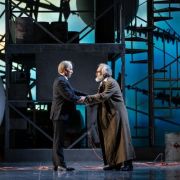
There was some sense of déjà-vu on entering the huge turbine hall of Geneva’s Bâtiment des Forces Motrices: the graphics and the printed programme were evocative of the Opéra national du Rhin in Strasbourg. It so happens that it is not just a visual identity that Alain Perroux – returning to his native city as general director of the Grand Théâtre de Genève – has brought back from his successful five-year tenure in Alsace; he retains the same ambition to acquaint as many people as possible with little-known and forgotten works.

With a zeal worthy of Jean Calvin, such a key figure in Geneva’s history, Perroux undertook to speak in person to the audience in the auditorium. He made an erudite and impassioned case for the work chosen to launch his first season with the company: La Tempête by Frank Martin (another native of Geneva), based on Shakespeare’s The Tempest and premiered (as Der Sturm) at the Vienna State Opera in 1967. Perroux’s enthusiasm was undeniably infectious as he quoted Prospero’s “We are such stuff as dreams are made on,” but what exactly is the stuff of La Tempête, a dream buried in the depths of memory for nearly 60 years?
In the event, rarely has an opera proved so bewildering. Thrilling epiphanies emerge from relative tedium in the course of an unruly, shape-shifting work that draws on numerous styles, moving from arias to the idiom of musical theatre by way of a kind of Sprechgesang. Of a demanding nature, it opts for accumulation and colour rather than dynamic impetus or overall coherence. Any attempt to grasp it demands caution – it is like a bunch of sea urchins.

The reason for this lies partly with the libretto. Frank Martin originally set a German adaptation of Shakespeare. Here it was given in a rather stilted French version, reworked from the German by Pauline Martin, the composer’s sister, for a production in Geneva in 1967. It cannot be compared with the skilled French translations of Shakespeare made by André Markowicz (b.1960) or Yves Bonnefoy (1923-1916); rather, it appears to take a lead from the sometimes scholarly literary meanderings of August Schlegel (1767-1845), whose versions of Shakespeare’s plays exercised a powerful influence on German Romanticism. The resultant articulations are not always readily assimilated.
When it comes to the music, the opening tempest is a model of Debussyesque impressionism. The opera then navigates a diversity of sonic waters, evoking en route Menotti, Stravinsky in neoclassical mode, Copland, the jazzier Ravel (spotlighting the solo saxophone and brass section) and even variations in the style of Monteverdi. Thanks to the expertise of Thierry Fischer, in the pit with the Orchestre de la Suisse Romande, the score was brought back to life with the requisite eclectic brio. The Swiss-based conductor was another driving force for the entire project, bringing his own passion to the revival of this hybrid work – which the composer himself refused to describe as an opera.

Fischer was accompanying a cast of first-class singers, worthy of their illustrious predecessors in the roles. Who better than Stéphane Degout to take on the mantle of Dietrich Fischer-Dieskau in the role of Prospero? With his impeccable diction, the eloquent French baritone held the audience in thrall from his first recitative. The same could be said for Catherine Trottmann as Miranda – a role created by Christa Ludwig, no less. She compelled attention with the impeccable clarity and limpidity of her singing.
Christian Immler made a suitably haughty Gonzalo, and Christophe Gay (Stephano) and François Rougier (Trinculo) were marvellously off-pitch in their “scurvy tune”. The flexibility of Julien Dran’s light tenor was welcome in the role of Ferdinand, though there was tightness in his top register, while Nicolas Cavallier’s Alonso was somewhat vibrato-heavy. Alex Rosen, with his resonant deep notes, remained a model of vocal stability, despite oscillating between frustration and submission as Caliban.

That being said, his character, like the others, was set in a disappointing theatrical context. Perhaps Netia Jones was so concerned with remaining respectful in her approach that her production became a kind of flat facsimile. It was solely rooted in the idea of Prospero as a mad scientist – on the lines Doc in Back to the Future – who used the revolving stage, occupied by his intricate technical apparatus, to transport the shipwrecked visitors to the island and to move them about. The characters were not developed in a way that did justice to the Shakespearean convolutions and a sense of monotony emerged.
For all that, the final impression was of a complex, unsettling work which, while not quite subjugating the audience, still proved fascinating, paradoxically leaving an impression of boldness and clarity. As Caliban says “The isle is full of noises, sounds and sweet airs.” If the programming of La Tempête represented a considerable risk, it was justified with considerable flair.
Translated from French by Yehuda Shapiro