Do we really believe that a lion would decline to eat an appetising Roman on the slightly absurd basis that said Roman had previously encountered the lion in the wild and had helped heal a wound? Donizetti expects us to suspend disbelief in L'esule di Roma, but in her interesting, if flawed, new production which opens this year's Donizetti Opera Festival in Bergamo, director Katharina Thoma refuses to accept this deus ex machina.

Thoma gives us a compelling argument for the dramatic merits of an opera bristling with intrigue, romance and fear. L'esule is set in that period of Tiberius' reign when he had departed Rome, leaving the city in the hands of the Praetorian Guard Commander, Sejanus. Senator Murena has betrayed the former Tribune Settimio, reporting him for treason despite owing his rank to Settimo's father. Settimio has fled, leaving behind the woman he loves, Argelia – Murena's daughter. As Publio, the general Argelia has been marked to marry by her father, returns, Murena is plagued by guilt; the arrival of Settimio, the revelation that he knows Murena was in on the plot against him, and Settimio's capture push Murena over the brink into madness, delivering a rare but sensational bel canto baritone mad scene. All ends well – Settimio survives thanks to the lion – and Murena reports himself to Tiberius, losing only his rank.

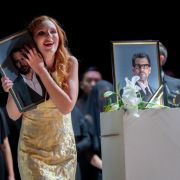
Thoma's staging, with a beguiling set design by Devin McDonough, is contemporary, but captures the strain of a permanent life of fear under autocracy. Among her conceits is the silent presence of Sejanus in a flashy white suit and ostentatious cape, a contrast to the black helmeted officers clearly inspired by recent scenes from America. Sejanus is regularly addressed, from Murena's frustrated address in Act 1 to the attempt by Publio to seek clemency for Settimio. The easy cruelty – he watches as Settimio is given his food in a dog's bowl – is compelling, but I wonder if the actual presence of power on stage is more effective than the sense of claustrophobic fear created by absence and mention.
McDonough's set is made of huge columns created by transparent drapes, which dwarf the singers while leaving large amounts of space. Video is projected upon these flowing curtains and at one point they run with blood. It's impressive, avoiding the dreaded grey box staging and giving us another game of power – space and scale is both a luxury of the elite, but also a demonstration of power. Thoma offers some striking scenes, including the silent younger daughter of Murena, Emilia, cowering under a bench as the chorus of impotent relatives surround her, hands stretching towards her as they demand that she – this child – do something.

A couple of minor criticisms: Luca Scarzella's excellent video projections largely work, but sometimes distract, particularly diverting attention away from Murena's opening aria “Per lui... nel mentre... avea”. As mentioned, Thoma finds it implausible that either Settimio and Murena survive, and so turns the finale into Argelia's own mad scene. It's reminiscent of John Dew's approach to I puritani and purists will be enraged, but even if unfaithful to the libretto, it makes for a rather watchable, if distracting end.

The festival assembled a strong trio for their opening production. Sergey Romanovsky sang Settimio in London and on Opera Rara's recording, and sounds eminently comfortable in the role, deploying his full-bodied and expressive tenor to excellent effect with magnificent forays into the higher register. He brought a consistent nobility to the role, even when his character, starving, scoffs a discarded sandwich. That first cavatina was sung with class and grace, and only lacked just a touch of flourish for the finale – a personal preference. Lidia Fridman brought similar poise to Argelia, with a soprano that hit all the top notes and delivered superb coloratura in the final number, "Ogni tormenti". She has a very distinct timbre to which the ear takes a few moments to get used, but her technique is solid. It was nice to see a genuine sense of chemistry between Fridman and Romanovsky which added to the pathos of the finale.

Luca Pisaroni's baritone is more elegant than burly, with a rich and secure lower register, more than comfortable in projecting over the chorus and orchestra. Pisaroni presented a character steadily breaking beneath his own guilt; by the second half, the shoes and tie are off and he is wandering wrapped in a blanket for the delivery of a magisterial mad scene. The forces of the Coro dell'Accademia Teatro alla Scala sang with gusto, while in the pit, taking the place of the late Antonino Fogliani, Fabrizio Maria Carminati led the Orchestra Donizetti Opera in a splendid reading of the score with much in which to delight. Tempi were on point, string texture was luxurious and there was always a sense of balance. Without question, a riveting performance.
Dominic’s press trip was funded by the Fondazione Donizetti