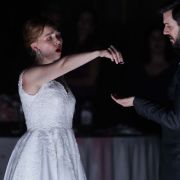
An irreverent and mordant attitude towards the nobility coexists in The Marriage of Figaro with a sense of intoxicated awe, as if, deep down, its frivolity and charm set it apart from everyday morality. Da Ponte and Mozart settled for this ambiguous balancing act, less overtly political, if you will, than Beaumarchais, likely as a matter of expedience in the Vienna of Joseph II. But what, at first sight, may seem to be self-censorship resulted in a musical and theatrical miracle. I open my remarks on the new production by Robert Carsen at the Teatro Real in this manner because I believe the essence of the work itself lies in this duality: there is, of course, political criticism, but there is also, above all, the will to uncover the frictions of the human character beyond the rigid social conventions of the day.

Carsen’s perception is successful precisely because he builds his characters up with a complexity that encompasses gesture, movement and even their clothing. There is a certain cheekiness and a touch of vaudeville in the constant use of hidden or switched identities but also the aspiration to escape one’s own limits and become someone else. One could say this is the work’s driving force, what makes it flow, and beyond the complexities of the plot, Carsen captures this essence brilliantly.

This is notably reflected in sets which imitate the Élysée, an ecosystem of power: a certain idea (of great relevance today) that proximity to power itself becomes power, with all the characters at the count’s court jockeying to obtain a favourable position, thereby creating a vicious circle they cannot escape. Hence their general happiness and contentment at the end. All of this is legible in the seasoned Canadian director’s staging, with no heavy-handedness: there are no cerebral excesses, no reduction to one sole concept, and even the contemporary elements eventually blend in naturally as the opera progresses. It is a mature reading, that understands Mozart’s genius, and, rather than add to it, removes any trace of naivety or caricature from the drama, without, however, losing one jot of the libretto’s intrinsic comedy.

Musically, Stefano Montanari’s vision went hand in hand with Carsen’s and this likely accounts for the success: Montanari went for sustained tempi, relished the recitatives from the fortepiano, whipped up a generous sound with natural horns and a compact and vibrant string section, entrusting the woodwind with the intricacies of the middle parts. The cast for this performance included the outstanding countess of Elsa Dreisig, whom we saw in last year’s Mitridate staged by Claus Guth. A somewhat lightweight soprano, but complete across all registers, she sang a moving “Dove sono”. As Susanna, Sabina Puértolas also shone as an actress and was solid musically, combining technical quality and expressiveness. Germán Olvera’s Figaro had good stage presence and a well-projected voice, though it tended rather too much towards the bass register, slightly diminishing the agility and brilliance the role demands at certain moments.

Carles Pachón’s Count Almaviva was correct and constant, though his emission was troubled at times, especially in the middle register, and his high notes were more characterful than clean. Lucía Caihuela’s Cherubino, something of a maverick, was more convincing theatrically than vocally: her “Voi che sapete” was finely delivered. Though a little wanting in emission and amplitude, she was loudly acclaimed. The other roles were well covered, adding the splashes of colour Mozart requires, making ensembles like the Act 2 finale or “Riconosci in questo amplesso” in Act 3, exuberantly expressed by Montanari, into the timeless moments of musical history they are.

The strength of this production resides in the happy combination of team work and the seriousness of the vision, which results in a lightness of touch and humour naturally present throughout the performance both in the conducting and the stage direction. This alignment cancels out individual shortcomings (which are in any case not too obvious) and produces that taut harmony that is the essence of the enduring charm of The Marriage of Figaro.
Translation from Spanish by Aaron Vincent