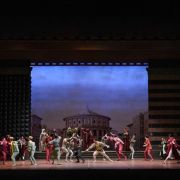
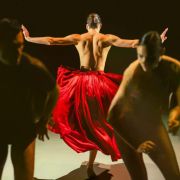
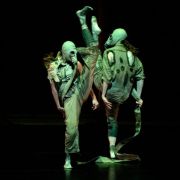
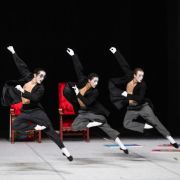
Ballett am Rhein are kicking off their season with a lean and electric programme featuring two bold and hypnotic works. In the Middle, Somewhat Elevated is perhaps William Forsythe’s most famous creation, first danced by Paris Opera Ballet in 1987 and last seen here in Düsseldorf in 1992. It’s paired with Sharon Eyal’s Strong. The Israeli choreographer’s work is often performed in Germany to much appreciation from audiences, with this more recent piece premiering in Berlin in 2019. With their pulsating rhythms and relentless physicality, it’s easy to see why they’ve been paired together, making for a gripping evening of dance.

The sight of iconic turquoise leotards with black tights layered over the top is instantly recognisable. Three men and six women pace the stage with apparent nonchalance and so begins the industrial clangs and clashes of Thom Willems thumping music. The ensemble are immediately locked in, channeling all their focus to deliver the signature bends and snaps of choreography with satisfying panache.


The succession of group, partnered and solo moments are woven through the short thirty minutes. Nelson López Garlo and Sophie Martin are thrilling together as the central couple. Garlo is a sturdy partner, allowing Martin great stability in the intricate pushes and pulls. Martin is equally slick and accomplished, hitting every bang and clash with a glorious extension or lofty jump. She manoeuvres her long legs with expert precision, like she’s threading a needle.
Impressive too was Balkiya Zhanburchinova who danced with sharpness and elegance, while Márcio Mota brought bags of charisma and attack in his solo. As an ensemble, the company copes well with the considerable demands required. The dancers have clearly put in the effort to develop the technical accuracy and strength needed to master Forsythe’s jerky changes of direction and sudden stops. Their concentration is evident, and there are moments when that focus is almost palpable. In the Middle is at its best when this explosive energy is combined with a more spontaneous approach but no doubt this can be achieved with time.

It’s a promising start to the evening, well received by the audience, but nothing could have prepared me for the response to Sharon Eyal’s closer. I’ll admit to having seen a few of Eyal’s pieces which tend to build slowly, drawing on small, repeated movement vocabularies that gradually accumulate into powerful conclusions. More than just choreography, however, Strong is a full theatrical experience.

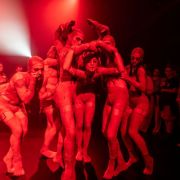
A large cohort of dancers, dressed in various creations of black mesh, stand close together, facing sideways to the audience. A soundtrack of spoken voices, muffled and initially impenetrable, soon gives way to a pumping electronic pulse (Ori Lichtik). What unfolds is difficult to describe while adequately capturing the skill involved. The dancers shuffle and shift subtly, their movements gradually finding a shared rhythm. There’s marching steps, échappés and repeated arm pumps which become the central building blocks and make for mesmerising viewing.


Individual dancers occasionally break away, petite Iris Dávila is particularly eye-catching with her delicate shapeshifting, repeatedly moving from foot to foot on demi-pointe. These outliers briefly dictate the movements before slipping back into the ranks, while the cycle repeats itself. These moments are skilfully created, Alon Cohen’s evocative lighting design brings focus to individuals before seamlessly bringing the main group back into focus.
At approximately 40 minutes, Strong is an engrossing work but it could perhaps be pruned to maintain impact and engagement. The lines and shapes would have looked even more fantastic in pointe shoes but perhaps the clatter would have broken the spell. Ultimately, the dancers can’t be faulted, their magnetism and mechanical unity keeps the audience hooked.

In the final moments, Rose Nougué-Cazenave emerges at the front of the stage and descends the steps towards the audience. She is teasingly close, while the main group fades into the background. She repeats the pumping movements up close, the beat intensifies, before a blackout. The ovation is instant, the audience giddy and euphoric at what they’ve witnessed.