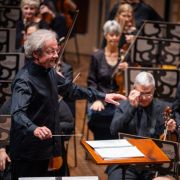
In a welcome complement to the outdoor offerings at Blossom Music Festival, The Cleveland Orchestra also presents a series at Severance Music Center branded as ‘Summers@Severance’. The first of this summer’s selections brought back guest conductor Semyon Bychkov in a hearty program of Eastern European fare, all dating from the last quarter of the 19th century. Currently Chief Conductor of the Czech Philharmonic, Bychkov bookended the evening with Czech composers – both works he opted to conduct from memory.

From the silvery flutes that opened Smetana’s Vltava, this was a program that transported the audience far away from the near-apocalyptic haze of the Canadian wildfires outside to deep in the heart of Central Europe. Often said to be the most European of American orchestras, TCO responded to Bychkov’s instincts with a natural fluency and the performances were saturated in an authentic Slavic flavor.


In Vltava, wispy streams coalesced into the mighty artery of the titular river that traverses Bohemia. The ebb and flow of the main theme was particularly captivating by the lushness of the strings. Bychkov’s reading was singular and cohesive without feeling episodic, despite the various stops along the journey: a lively wedding in the countryside, mystical water nymphs emerging by night and the river’s final sweep past the fortress in the Czech capital – a moment marked by a sturdy theme with zealous brass and percussion.
Dvořák’s Symphony no. 8 in G major saw melancholy beginnings, quickly giving way to a warmly bucolic vista. But the conductor teased out much drama in the climactic development, with particular attention given to the clarity of the inner voices. The lilting abandon of the charming third movement was played with the right amount of flair before a trumpet call heralded the finale. It was clear Bychkov conceives this symphony as not simply a sunny affair, again finding much opportunity for drama and contrast, pointing towards a boisterous, brassy close.
Situated between the Czech works was a Russian interlude in Rachmaninov’s Piano Concerto no. 1 in F sharp minor. Overshadowed by the composer’s later, greater works in the medium, the First is nonetheless a richly attractive work that already bears many of Rachmaninov’s hallmarks – a remarkable achievement for an 18-year-old conservatory student (though presented here in its more commonly heard revision from some two decades later). At the piano was Garrick Ohlsson, a masterful interpreter of Rachmaninov and one of The Cleveland Orchestra’s most cherished collaborators.


A thunderous cascade down the keyboard began this youthful effusion and Ohlsson played with leonine power that resounded through the hall. A languid and lyrical theme contrasted, drawn out by sorrowful strings in quintessential Rachmaninov fashion. Ohlsson was just as impressive in the light and fleet passages, crafting a delicate latticework. Though the cadenza of the Third Concerto has a justly daunting reputation, that of the First proved hardly less impressive. With artful phrasing, Ohlsson’s passionate playing soared to coruscating virtuosity.
The central Andante opened as a doleful lament, with delicate writing in the piano engaging in a soft-spoken dialogue with the orchestra. The exuberant finale was a nearly nonstop romp across the keys with a prominent part for triangle adding an orchestral shimmer. Ohlsson quipped that his encore was a “piece too famous to announce”, an apt description for Debussy’s Clair de lune! Written about the same time as the concerto, it made for a touching complement, a moment of introspective, luminous poetry.