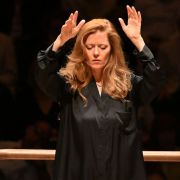
Identity in American music is as diverse as the nation itself. In her Cleveland Orchestra program, soprano-turned-conductor Barbara Hannigan offered four possible visions of American music that spanned the 20th century. Each was distinctly American yet wholly unique from the others. The first half considered two maverick iconoclasts, George Crumb and Carl Ruggles — hardly standard Valentine’s Day fare!

Crumb’s A Haunted Landscape dates from 1984 and, like most of the composer’s output, makes use of a panoply of extended techniques for a striking, sometimes shocking, aural palette. Upon the hammered strings of the piano which opened, one knew this was going to be unlike anything in the standard repertoire. An eerie, phantasmagoric soundscape was painted, and not without a certain entropy and unpredictability, tenuously oscillating between violent climaxes and empty space. Hannigan showed command of the challenging work, conducting with clarity and intention in one of the most distinctive works I’ve heard emanate from the Severance Hall stage.


Completed in 1931, Ruggles’ Sun-Treader was the earliest work on the program, but hardly less forward-thinking. The title alludes to a poem by Robert Browning, and the score makes sophisticated use of a strident atonality. Bracing beginnings brimmed with the rigor and severity of the avant-garde. Densely textured, its brassy dissonances were unashamedly iconoclastic, in no way gentle on the ears. TCO recorded the work under Christoph von Dohnányi, and while that remains a compelling listen, I found Hannigan rather less convincing here.
Samuel Barber and George Gershwin are composers who one might more readily point to as emblematic of American music, and works by them comprised the more audience-friendly second half. Barber’s Knoxville: Summer of 1915 scaled the orchestra back to modest dimensions and introduced soprano Johanna Wallroth in her US debut. This intimate portrait was warmly atmospheric, painting a quintessential scene in small town America, and it’s a piece Hannigan surely must know from the singer’s side as well. Wallroth had a warm and soft tone, well-suited to the work’s wistful nostalgia, though sharper diction would have better conveyed the poignantly descriptive text by James Agee.


Just a few years after Gershwin’s tragically premature death, conductor Fritz Reiner commissioned Robert Russell Bennett to make an orchestral suite based on Porgy and Bess. The resulting “symphonic picture” ingeniously captures the essence of the opera in about 25 minutes, seamlessly melding its memorable themes. Gershwin’s idiosyncratic orchestral coloring was apparent from the opening bars. A clarion trumpet solo from Michael Sachs was tinged with blues, and answered by a battery of alto saxophones. With boisterous abandon, a lively scene on Catfish Row was brought to life, even in the absence of text and sets.