This year’s Bucharest Opera Festival has presented an illuminating comparison between Rossini’s two most bankable, enduring operas. A year after Il barbiere di Siviglia met a notoriously chilly reception in 1816, the composer and his librettist Jacopo Ferretti reprised and refined a number of its themes in La Cenerentola. Sharply contrasted stagings made a much more serious and substantial work out of the later opera, even if still infused with the spirit of theatrical delight.

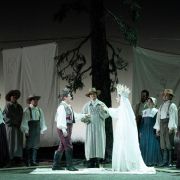
If the director Paolo Bosisio was working to a tight budget in Galați, he used the money shrewdly. Domenico Franchi’s simple and stylised designs evoke the cutouts of Matisse, the geometric order of de Chirico, and then more classic visual archetypes of playing card characters and Pierrot. The imagery underpins a neat balance between stylised and naturalistic action, so that the old tale feels at once timeless and present. As revived by Adrian Marginean, the production effectively expands to fill the considerably larger stage in Bucharest.


The lighting, alas, does not. In theory, a half-lit “Zitto, zitto, piano, piano” sharpens the conspiratorial blade of the duet between the disguised Prince and his valet – but we should at least be able to see their faces. Thrown into shade for much of the time – though Act 2 brightened up – the cast often sang out as though anxious to prove that they were really there. A resulting brittle edge and rigid tread to large scale ensembles such as the Act 1 finale felt all the more regrettable when conductor Cristian Sandu was taking care to keep the orchestra down and the rhythms well-pointed: his Rossini crescendos were the real deal, and the second act storm lashed down with positively Beethovenian violence.

However, when not over-projecting, the cast proved worthy of the Galați company’s growing reputation as a notable proving ground for young Italianate voices, demonstrated by previous appearances at the Festival such as La bohème in 2024 and Lucia di Lammermoor in 2025. After a decade in Galați, Florentina Soare joined the Brașov Opera in 2023; her Angelina/Cinderella stirred warm memories of a sumptuously sung La Frugola, in the Brașov company’s staging of Il trittico. In a production which demands both singers and audience to take Cinderella's plight seriously, Soare’s rich mezzo exuded nobility from her initial folksong. A few low notes went by the board in her culminating “Non più mesta", but she always combined vibrant tone with on-the-nail coloratura.
Alin Munteanu’s beefy Enrico in last year’s Lucia likewise left a strong impression revived by his Dandini, a most plausible Prince, both in voice and stature. The Alidoro of Constantin Lupu was a little compromised by being largely consigned to the back of the stage, as the putative author and moving authority behind the story, but in an opera of three lead basses, his stern presence contrasted nicely with his colleagues. While reprising the broad buffo humour of his Bartolo from Friday night’s Barbiere at the festival, Iustinian Zetea brought a shade of iron to Don Magnifico, making his abuse of Angelina painfully clear to witness.


By turn, the unyielding heartlessness of the ugly sisters stepped out of the fairytale frame thanks to the technical security of Mădălina Postolache as Tisbe and especially Lorena Mărginean in her white-hot showpiece “Sventurata! Mi credea”, which fairly brought the house down. Up to that point, the evening’s vocal highlight had undoubtedly belonged to the Ramiro of Dumitru Filip, who earned his shamelessly sustained high C at the climax of “Si, ritrovarla io giuro". His ringing commitment to Cinderella left no room for doubt – though, thanks to Soare’s graceful command of the stage, I also wondered who would end up wearing the trousers in this particular fairytale marriage.
Peter's trip to the Bucharest Opera Festival was funded by the Bucharest National Opera.