Opera has been running through Speranza Scappucci’s blood since childhood. “When my father was a teenager, growing up in Rome,” she tells me, “he and his brother would go to the opera all the time. This was in the golden age of the 50s and 60s. He saw all of the greats, including the famous Maria Callas Norma.” Music was always playing on the radio. “When he drove us to school, he would put the classical station on and we would play a game to guess who the composer was.” That early grounding paid dividends. At the start of this season, Scappucci took up the post of Principal Guest Conductor with The Royal Opera.

It followed a successful house debut in July 2022 when she conducted Verdi’s Attila in a single concert performance. But I’d already seen Scappucci in action twice by then, at the Opéra Royal de Wallonie-Liège, a delightful corner of Belgium devoted to Italian repertoire. Jérusalem – Verdi’s French revision of I Lombardi – was Scappucci’s first project there as Music Director. The pacing of the performance and her care for nurturing the vocal line was hugely impressive, as was her firecracker Aida there the following season.
Scappucci was at the helm in Liège for five seasons, at the end of which came the dual challenges of the global pandemic and, in February 2021, the death of Stefano Mazzonis di Pralafera, the house’s artistic director. “It was a huge learning process about what it means to be a music director,” she reflects. “The fact that you're so involved with the house and anything that is musical – the orchestra, the audition process – taught me how to deal with my own emotions, about how to handle situations.
“In those five years, I grew a lot through various experiences. Some were very good, some were less good, but you come to terms with what are your strengths, what are the things that you can improve, not only as a musician, but also as a human being. And how to communicate with people, because you’re part of the family, but you’re also in charge of that family.”


“Because the last two seasons coincided with Covid and the loss of our general director, a big chunk of programming was cancelled. After Mazzonis’ death, I took over the theatre for a few months. We went into streaming performances and I reprogrammed things to try and make sure that the theatre could survive artistically. That was also a very strong experience for me. I find myself in situations today where I think, at the beginning of my music directorship, I would have been much more emotional. Now I'm more in control. You can draw something positive from anything, even negative situations.”
Scappucci is full of praise for the leadership of Liège’s new General and Artistic Director, Stefano Pace, especially the way he has broadened the repertoire. “It’s now a house where you can go and see German, Russian and Czech repertoire as well as the Italian classics. Times change, audiences change, so the important thing is to be faithful to tradition, but also be open to something new.”

Looking back, Scappucci tells me more about her early operatic experiences. “One of the first operas I saw was Bellini’s La sonnambula starring June Anderson in Rome, when I must have been around ten. And then there was the famous Carmen with Plácido Domingo and Julia Migenes at the cinema. I fell in love. I went to see that movie, I think, three or four times. Then, as a teenager, I once had the flu and couldn’t go to school for a week. My dad put a cassette player by my bedside with Manon and Carmen – strangely enough, two French operas – telling me, ‘Just listen to this. It’ll keep you company.’ When I conducted my first Carmen, all those years later, all these memories came flooding back like flashbacks.”
So opera had always been part of Scappucci’s life, but she initially wanted to be a pianist. “I went to Juilliard as a solo pianist, but because I did a lot of chamber music, I got into Lieder, playing for song recitals, and eventually went into opera coaching. That’s how I shifted into the opera world. That’s how the passion came around.”
I suggest that the role of the répétiteur – coaching opera singers, playing for rehearsals – is one of the most under-appreciated in the business. “Well, it depends who you talk to,” Scappucci responds. “I think in the actual opera house, it’s considered a really important job. For me, it’s the key role in any opera production. Without the pianist, you can’t do anything – you can’t coach, you can’t do rehearsals. The pianists have to be really good. They have to be able to play orchestrally; they have to know how to take notes, how to assist the conductor. It’s a fully-faceted, multitasking job.”
It’s also a highly psychological job, supporting singers, especially those learning a role. This experience has informed Scappucci’s approach to conducting. “Whether I’m working with big stars or lesser known singers debuting a role, having that experience of coaching means I know how to talk to them, how to find solutions. I always feel like the conductor has to have a complete vision of the piece, a really strong idea musically. But then you’re also faced with the fact that you have singers who have their own needs. No two sopranos will be the same as each other, so you have to adapt your own ideas and be flexible. That doesn’t mean to be subservient to the singer, it just means working collaboratively.”

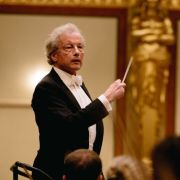
Riccardo Muti was an important early influence. Scappucci met him at the Wiener Staatsoper in 2005, after which she played piano and coached for several years on his projects – including the famous 2011 Otello at the Chicago Symphony Orchestra. “What was really great about our collaboration was that he has a very serious way of looking at the score and trying to dig the truth behind the notes. I already had a strong work ethic, but living that next to someone who lives music like Muti does was definitely inspirational. Mostly what I perfected with him is the connection between the text and the music and how the orchestra is never secondary to the singing and the singer is never secondary to the orchestra.”


In 2022, Scappucci made her debut at the house Muti led for two decades, the Teatro alla Scala. She became the first female Italian conductor to take the podium there, jumping in for an ailing colleague to conduct I Capuleti e i Montecchi as the opera world emerged from the pandemic. “There was no time to think about what was happening. I was driven by the fact that I had this chance to do a great Bellini opera with this amazing orchestra, chorus and cast,” led by Lisette Oropesa and Marianne Crebassa. “I tried not to focus too much on the fact that I was where I was and what that meant historically.”
“It was very emotional for me. The premiere was one of the most important nights of my life, just because of the history of that theatre and the feats that have been achieved on that podium. You think, it’s so huge, who am I to stand here? And that has nothing to do with the fact that I’m a woman. I just felt so humbled by the whole situation. I’m very grateful to be going back this season to do Lucia di Lammermoor.”
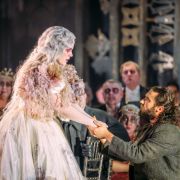
Because Scappucci’s schedule was already quite full by the time her Royal Opera appointment was announced, her appearances at the house are initially limited to once or twice a season. Last autumn, she led performances of the revival of Verdi’s Les Vêpres siciliennes in her new role as Principal Guest Conductor. “It’s a house that functions very well,” she enthuses, “and the artistic forces are amazing. The chorus is probably one of the best in the world and so is the orchestra. I’m excited about this role.”
“Vêpres hadn't played there for nearly ten years. Everyone on stage was either debuting a role or debuting it at Covent Garden so it really felt like a new production… except that we didn’t have the same number of rehearsals that a new production would have! But that’s where the excellence of the crew, the musicians and the artists came out because, even in a short time and with fewer rehearsals, we were able to put on something exceptional.”
Away from the pit, Scappucci is a passionate sports fan, cheering on Italian tennis star Jannik Sinner as well as being an ardent – sometimes long-suffering – fan of Juventus. Are there parallels between managing a football team and leading an opera house? Scappucci laughs. “Let’s just say Juventus hasn’t been so lucky with managers lately!” she begins ruefully, “Although the manager we currently have, Luciano Spalletti, is turning out to be really good for the team right now. We don’t have great stars, except for maybe a couple of players. To be a leader, you have to believe in your team and you have to motivate the players to give their best.”
We share thoughts about great football managers – Carlo Ancelotti, Zinedane Zidane, Jürgen Klopp – as she warms to her theme. “A good manager pushes his or her players to give their best, not just to be the star, but to contribute to the team. It’s the same with orchestras.”

Having conducted at the Met, at La Scala, the Opéra de Paris and Covent Garden, it seems that all doors are open to Scappucci. If given the choice, which opera would she love to conduct at any one of them?
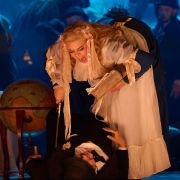
“Now that I’ve recently debuted Otello in Strasbourg, I’d love to do it again,” she says. “To be able to do it in a house like Covent Garden where I also have a title would be stunning. In all of his operas, Verdi is excellent at that marriage between words and music, but I would say that Otello is absolute perfection. He’s already developed his writing so there is no such thing as an aria. It’s just a stream of thought – endless music. The fact that people applaud after the Ave Maria, for example, is just wrong because there’s absolutely no ending at that moment. It’s like touching heaven with the end of the Ave Maria, the A-flat up in the violins – and then it dives directly down into those low double bass notes in hell, Otello coming in to kill her. It’s pure theatre.”