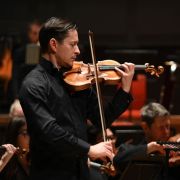
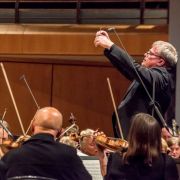
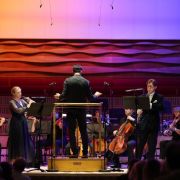
A foray into the music of the 18th century for their latest concert was something of a novelty for the Belgrade Philharmonic Orchestra and its audience. It was conducted from the violin by specialist in historically informed performance repertoire Julien Chauvin, making his local debut. Chauvin directed energetically and the orchestra responded in kind, seeming to respond to each other instinctively. One would not have guessed that this was not the Belgrade Philharmonic’s usual material.

The first half comprised two works by Carl Philipp Emanuel Bach, the prolific and influential son of Johann Sebastian whose career was based first in Berlin and later in Hamburg. His compositions were highly regarded in his day but are little performed nowadays. His works spanned the styles of the 18nth century from the Baroque to the Classical periods, crucially bringing greater expressivity into orchestral music. The Symphony in D major, Wq183/1, was from his time in Hamburg and written for strings and wind. Chauvin led us though a dramatic opening movement, a gently flowing melody in the central Largo and an energetic, buoyant Presto finale. The orchestration was inventive and the whole work refreshing and exciting. Lasting only 11 minutes it was remarkably concise and left us wanting more.


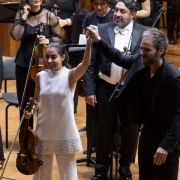
The soloist in CPE Bach’s Flute Concerto in D minor was Ana Kaličanin Radivojević, former Belgrade Philharmonic principal, who evidently had many enthusiastic supporters in the hall. Her sparkling fingerwork and breath control were amazing, but never detracted from her expressive playing. The concerto had a more Baroque feel than the symphony. It was a much earlier work, dating from the composer’s time in Berlin at the court of Frederick the Great (himself an accomplished flautist). A lovely solo in the central slow movement was a highlight. In response to the applause Kaličanin Rodivojević, Chauvin and two others gave us a movement from Mozart’s Second Flute Quartet by way of encore.
The second half of the programme presented two symphonies by Haydn, one familiar but the other much less so. The Symphony no. 39 in G minor is a richly diverse work, characterised by appealing melodies throughout. Chauvin made a particular feature of the pauses that punctuate the lively first movement. In the second, he brought out the contrast between loud and soft. The Minuet had an engaging lilt and the sonority of the horns gave it a distinctive feel. Unusually Haydn had four horns rather than two at his disposal at the time of composition. The finale was stormy and rousing.
The story behind the nickname Farewell given to Haydn’s Symphony no. 45 is well known: a witty hint to the orchestra’s employer, Prince Esterhazy, that the players were tired and needed to go home and spend some time with their families. In his introduction, Chauvin added an extra element that I had not heard before: the reason the symphony was in an obscure key (F sharp minor) and was difficult to play was to show that even if the orchestra was tired they were still so accomplished that they could play this demanding music. Chauvin gave us an expansive account of this fine symphony, which ended with the lights going out and the players leaving the stage until only two were left. They all came back for applause – and an encore.