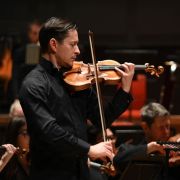
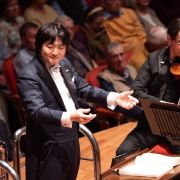
Tuesday’s City of Birmingham Symphony Orchestra concert might well have been titled ‘Molto Cantabile’. From the moment Ilya Gringolts launched into Prokofiev’s Violin Concerto no. 1, it was immediately established that this was to be an evening of unceasing song.

Gringolts was perhaps a bit too earnest in this regard, although the way Ilan Volkov encouraged the CBSO to take a back seat here contributed strongly to that impression. Violin as cantor, as orator, as rhapsodist, though after a while one began to realise how dynamically flat it all sounded, paradoxically making Gringolts seem to be treading water.
It took the central Scherzo to shake things up a bit, moving through its standard-issue Soviet stylings (of the sweet, fun and larks persuasion, rather than its sour, ironic counterpart), melody now channelled by momentum. By the final movement something more meaningful was taking place, curiously sounding like a slowed-down scherzo, as if revealing a hidden song lurking within, Volkov bending the tempo around its corners and gear changes. It became a curious mix: Gringolts determined to keep singing as if his life depended on it, the orchestra exploring more varied and arguably more interesting ideas behind him, finally teaming up for a somewhat over-sugared conclusion.


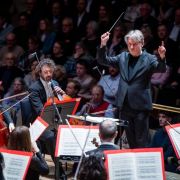
From the saccharine to the sublime. The song continued in Bruckner’s Symphony no. 7, but now the entire attitude was changed. A perfect cello melody, built on arpeggios (already anticipating the work’s end), was soon fanned into a brass blaze, the violins expanding from infinitesimal to radiant, and back into tenderness. Even more than before, melody always on the move, both in terms of instruments – passed from player to player – and harmonies, song as liquid. Earlier on, Volkov allowed the work’s eccentricities to speak clearly. The opening Allegro’s breakdown to just winds, answered by soft strings, and its subsequent brash anguish, felt appropriately odd. It was folded in turn back into the now darkened theme and somehow, seemingly impossibly, into the recapitulation. Structure as liquid too.

The unceasing song reached an apogee in the Adagio, the CBSO rendering it by turns sombre and bright, Volkov driving it forward and thereby minimising that sense of Bruckner as the composer of ‘blocks’, flowing seamlessly. To an extent this smoothed over some of the strange, and perhaps overemphasised its reliance on repeated motifs. Yet if anything this anticipated the Scherzo, song now modulated by rhythm, rippling its surface and for the first time creating real propulsion. The retreat into familiar lyricism in the Trio made one briefly wonder if Bruckner actually begrudged composing scherzos, yet the way Volkov whipped up the subsequent return of rhythm into a glorious, thunderous conclusion emphatically suggested otherwise.


Nonetheless, through the opening minutes of the Finale its song felt slightly peculiar, as if needing to recalibrate after the more metric Scherzo. But in no time the music found its feet, affirmed in the marvellously unexpected, grandiose fanfaric twist on the main idea, which the CBSO made positively huge. There were echoes of the Adagio in the way they pivoted between this overwhelming weight (the orchestra’s heavy brass sounding downright monolithic) and the lighter jauntiness from which it sprang. By now, the emphasis on melody obscured the oddities such that the solution to the pivot seemed inevitable. Weight and light combined in an immense, ever more luminous cascade of arpeggios, bearing the song aloft, skipping and laughing to its zenith and beyond.