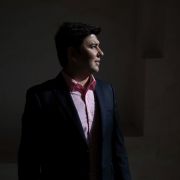
Thomas Jefferson once said we need a revolution every 20 years. He was talking about government, of course, but it may be just as true for the concert hall. The suggestion raises a question though. A crucial one. When overthrowing regimes – or performance traditions – to whose benefit is the uprising meant to be? At the Baryshnikov Arts Center in Manhattan’s Hell’s Kitchen, pianist Clara Yang and video artist Xuan’s Ex Machina broke with conventions and disposed of expectations. In so doing they left open the question, who is the concert for?

The performance, part of Carnegie Hall’s ‘United in Sound: America at 250’ festival, was like a mixtape of ten piano pieces, including works by Christopher Cerrone, Reena Esmail and Philip Glass, played nearly without pause while a flow of animated abstraction was projected on a large screen behind the pianist. It was performed in near darkness, without house lights. Those failing to memorize the program and sequence in advance were forced to accept it as an installation, an experience, something like the trend of sensory explosions spurred on by traveling Van Gogh spectacles over the last 20 years.


The program began with Esmail’s Crystal Prelude no. 1 with a backing track of, it seemed, birds and a babbling brook. Yang showed a delicate touch while something like a revolving moonscape rose above her. From there it was difficult to follow until an imminently recognizable Philip Glass étude (no. 11), during which Yang displayed a striking balance of gentleness and musculature. It was a welcome offering to occupy the cerebellum.

The hour-long concert felt at once meditative and too much to take in. The prerecorded tracks (in some pieces) brought acoustic guitar, soft processed beats and second piano tracks into the audio mix. The video added such elements as jittery flashing concentric yellow circles, Spirograph-like designs and masses of text in illegible script. Let's leave it at tastes vary and this isn't a visual (or intersectionality or some such buzzword) arts journal.
There are so many things that might have been done to assuage the anal-retentive attendee. Traditional body language could have signaled the ends of individual pieces. Names and titles could have been projected onscreen as the program progressed. But really, the concept would have been better suited for sinking into a single, extended work.

Nebulous though the program was, it was mostly uplifting, or reflective and unchallenging anyway, until the final piece. Cerrone’s Hoyt-Schermerhorn was accompanied by a fairly desperate text on screen (in script again but more legible this time): “How do you practice compassion / How do you fall apart / I want the darkness.” Eventually only the word “pain” was left on screen, then completed as “pain is living”.


Who was the concert for? With murky credits, it came off as at least a mild disservice to the composers (and the text applied to Cerrone’s piece struck as incongruous). Was it for the audience? Maybe so, depending on their expectations. It was well-received in any event, but standing ovations are nearly the norm nowadays. It seemed mostly for the pianist and video artist and we were just there to watch – which is what an audience is for anyway.