The control that a composer exerts over a performance of their music is largely dictated by custom: in the Baroque era, composers were happy to set down little more than the notes themselves and then trust the performer to play appropriately, but by the 20th century control-freaks like Debussy, Barber and Messiaen were notating every nuance, every change of embouchure or pedal position. Morton Feldman in his epic Crippled Symmetry – is it a work, an event or a collaboration? – relinquishes control of placement and dynamics to the three players, within a very strictly designed and fully notated score.

In particular it is not specified how the musicians are to coordinate with each other, so that repeated patterns which on their own could have a symmetry, are altered in the listener’s perception by these patterns’ relationships with what the other musicians are playing. Every new performance is an event in itself rather than a simple reading of the score – new patterns arise and changes of phase occur: the potential for symmetry is crippled, although that is perhaps not a word a composer would choose nowadays.


If this is a masterpiece – and I’m still unsure, although it is certainly shot through with the gold of greatness – then it has as much to do with the calibre and creativeness of the players as it is due to the composer.
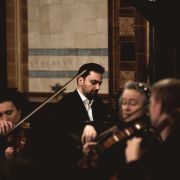
In this BBC Proms performance, the three players were sited in a triangle within Sage 2’s decagon and surrounded at floor level by a lattice of warmly lit LEDs punctuating the tenebraic near-darkness. Feldman’s mesmeric patterns, hardly a note louder than mezzopiano, unspooled like late Schubert piano music in a time seemingly of its own making. Anchoring the entire piece were the sevenths and ninths of Helena Gourd’s flutes, sounding as though they reached us as a weather warning from another, distant, world. Gourd clearly enjoyed herself throughout, with an occasional raised eyebrow and a hint of a smile at a particularly jazzy fragment and a gently twitching right foot providing a clue to the inner rhythm of her interpretation. This was playing not only of insight but also technically so secure that we could concentrate, as no doubt we were intended to do, on the patterns within the larger structure.

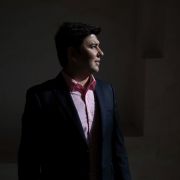
Bare ninths were a recurrent feature in the piano part too, particularly in the later stages, giving the listener something to hold on to amid the continually shape-shifting, shimmering sound-world. Dinis Sousa, hunched at the piano and celesta like a predator, with a tangibly ferocious calm and concentration, played tender, delicate intervals with remarkable evenness and an impressive control of dynamics. Jude Carlton was the most calm and inscrutable of all, poised over his impressive array of tuned percussion like a surgeon at the table, conjuring a vast range of different textures and harmonics, a cradle of what felt at times like neither silence nor sound but something new and different, created in-between the two. This was playing of extreme beauty, most notably in the rapid repeated diminuendo figures of the glockenspiel which ended the work.


Though brilliantly conceived and written by Feldman, this was somehow more than music, it was a sharing of the minds, sound worlds and imagination of these extraordinary players. If I have awarded this concert five stars, it is only because I cannot award six.