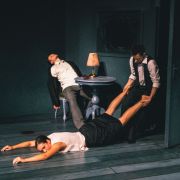
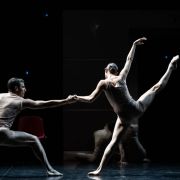
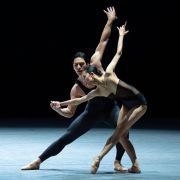
International Theater: Rabozaal presented a new work choreographed by Serbian-Dutch choreographer Dunja Jocić in association with Orbita | Spellbound Contemporary Ballet of Rome. The piece was a 60-minute dance triptych that took inspiration from red-lit nightclubs, folkloric movements and religious symbolism with colonial undertones.

If this sounds like a tall order, spoiler alert, it was. While the eight dance artists formed a compelling unit, the piece was somewhat derivative in its contemporary movement and lacked overall cohesion.
It’s apparent with Folk that Jocić has a handle on direction and is not without ideas. Perhaps her time dancing for Peter Greenaway has influenced a kind of ‘more is more’ sensibility with Folk playing with pseudo-sexual connections tinged with hints of gaudiness and goth. Upon entering the theatre, a light mist permeated the auditorium. The eight dancers slowly entered the stage to a muted techno beat, their costumes blurring the lines between streetwear and steampunk.


Soaked in red light, the dancers twitched in time to the beat, writhing in hedonistic pleasure, traversing the stage on demi-pointe. Nowadays, the sight of a pulsing mob on tip-toe seems to have become a universal gesture for contemporary dance. However here, the movement lacked the kind of depth and gravitas I have seen in other choreographers’ works. Moreover, the dancers lip-syncing to the vocals of the industrial electronic music made the opening feel like I was watching an extended music video with dance elements. Interestingly, upon further research for this review, there is in fact an official dance film of this opening segment on YouTube.

I thought the strongest segment of the night was in the middle where Jocić leaned into traditional forms of Yugoslavian folk movement set to balkan beats. Here, the group work seemed to coalesce into a unified sense of purpose, using the space to create interesting daisy chains, grabbing each other’s waist belts to form a line of stomping feet. However, the weighted movement vocabulary and quality couldn’t escape the semblance to other dance pieces that permeate today’s contemporary landscape.
I would have preferred it if Folk delved deeper into this concept of folk-inspired movement but instead the piece seemed to transition into other ideas that left me somewhat confounded. Giovanni Visone performed a compelling solo only slightly disrupted by the undressing of his dance colleagues in the peripheral shadows. As his solo continued to unfold the other dancers removed their costumes to reveal flesh-toned under garments. The dance trio between Visone and two other dancers became almost biblical in nature with Visone mimicking serpentine gestures while the others engaged with him as a kind of Adam and Eve.


In his final transfiguration Visone lay motionless on an elevated surface where the dancers dressed him in fragments of a period costume, the flourish of a white collar conjuring images between religious and royal, hinting at possible colonial ties. All of which can make for a rich tapestry of interwoven ideas and gestures, however Jocić's vision felt like an exploration without a clear intention.
Overall the dancer’s were committed and showed much skill and talent. It was clear that they worked well as a unit and put in the time to bond as a collective. I am less convinced by Jocić's choreographic offerings though I can attest to its creativity. Unfortunately, with Folk, the ideas were plentiful but lacked in originality and execution.