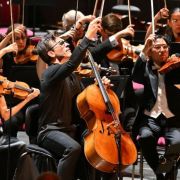
“In the 20th century, the nations of central Europe experienced both glory and terror – and composers responded with music that blazes with energy and imaginative power.” This is the guiding inspiration behind the first of this week’s mini-series (two concerts) from Edward Gardner and the London Philharmonic Orchestra, titled ‘Phoenix Lands’, and the stage did indeed blaze.

Grażyna Bacewicz (1909-1969) wrote her Overture in 1943 during the German occupation of Poland, but you wouldn’t catch that dark context from its exuberantly racing va-va-voom. From Gardner and his orchestra it came fleetly crisply clean-edged and momentum-filled. Plus, with ensemble strings virtuosity a key ingredient of its thrill factor – Bacewicz having been an accomplished violinist who served prior to the war as concertmaster of the Polish National Radio Symphony Orchestra – the clean rapidity of the LPO strings’ bowing was as exciting to watch as their music was to hear, and especially as they accelerated into its glittering final straight.


Bohuslav Martinů’s Violin Concerto no. 2 was written for Mischa Elman during that same year of 1943. Martinů was by this point an emigré in the US, his association with the Czech resistance having placed him in the Nazis’ line of sight. That dangerous context is clear and present in the concerto’s opening dark-towering, harmonically-scrunching iron fist of orchestral sound wall – although the ensuing journey is one of constant stylistic and emotional flux, with folk elements and high soloist virtuosity its prominent defining features. In the Royal Festival Hall, Gardner unleashed that mighty opening chord as a slow-slamming growl of austere might.
Then, with the stage compellingly set for the soloist, young Czech violinist Josef Špaček proceeded to make a highly auspicious LPO debut. Here was steely, power-filled lyricism; mesmerising, clean-as-a-whistle bow control across his high-speed virtuosities – which tended to be cooly attacked from off the string for a deliciously semi-wild folkiness and super-high definition, even across the trickiest double-stopped passages; atmospheric colouring with wide and fast vibrato, pronounced portamento and digging bridge-rattling into his strings when the music got throatily passionate. From everyone, the central Andante moderato delivered wonderfully on switching the intensity dial downwards to a lighter, brighter pastoralism. The only slight shame was the between-movement break preceding it being very much a break in the performance – no re-tuning, but faces and body language stepping fully and for slightly too long outside the score’s world. After a blistering finale, Špaček gave us Dvořák’s Humoresque no. 7 as an encore, played with old school romance to a supremely blended, dark-toned first-desk trio accompaniment of violin, viola and cello.


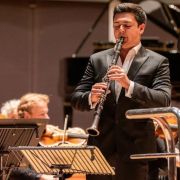
A gripping account of Lutosławski’s soul-filled Fourth Symphony began the concert’s second half. A Los Angeles Philharmonic commission which premiered in 1993, it employs a huge orchestra – including two harps, piano, celesta and varied percussion – and offers a constantly shifting collage of polyrhythms, textural and timbral contrasts, and solo opportunities. This tautly steered reading had vibrancy and virtuosity in spadefuls. Instantly notable was how its opening clarinet solo, launching over the strings’ polished chordal sea, had not only lyricism but an invigorating, piquant energy. And so it continued. At work’s end, Gardner’s face said, “Just look at them. Aren’t they something?’ And they were – underlined still further by a smouldering, narrative-exuding Taras Bulba, Janáček’s 1918 depiction of bloody Cossack resistance against Polish adversaries, dedicated to the Czech army resisting German forces. It now also brought in the width and swell of the mighty Royal Festival Hall organ. The work’s climactic chord, bristling with dirty brass, was a corker. What a night. If you can make it to the 6th February sequel, you should.