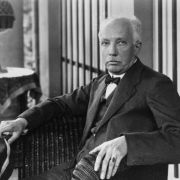
The Vienna Philharmonic is, of course, not a period ensemble. Yet few orchestras could carry such an unmistakable sense of period memory simply by stepping onto the stage. With this Richard Strauss programme, one could hardly avoid recalling the world described in Stefan Zweig’s memoirs, that “secure world under the reign of Emperor Franz Joseph”. It was an era when art was a matter of public urgency: when streets and cafés buzzed with arguments over the newest plays, the latest literary sensations and the most recent musical premieres; when artistic creation was met with an intensity of belief and emotional investment that now feels almost unimaginable.

The opening of Strauss’ Don Juan sounded like a plunge back into that vanished world. The tone poem began with unbridled energy, surging forward with muscular orchestral power and saturated colour. This was Strauss at the outset of his career – audacious and determined to conquer. Inspired by Nikolaus Lenau’s more introspective vision of the legendary seducer, the work unfolded here more as an existential trajectory. At its centre, the oboe solo emerged with touching clarity amid the orchestral tumult. The final collapse was thus allowed to register as resignation: a hero who recognises the futility of endless yearning and willingly accepts his end.


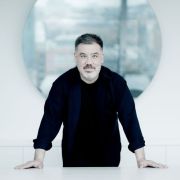
Daniel Harding’s conducting was economical and unsentimental, focused on sustaining long spans and shaping coherent large-scale breathing. One had the impression of standing before an enormous Rubens-like historical canvas – multiple perspectives, teeming energy, all governed by a single dramatic logic.
After the interval, Don Quixote brought the evening’s nostalgia into a more intimate register, as if inviting the audience into a familiar literature salon conversation from that old world. The solo cello sang with noble warmth and a slightly fragile dignity, the viola, often joined by the bass clarinet, gave Sancho Panza an earthy, affectionate presence. Around them, the woodwinds and strings responded with a strong sense of collegial dialogue.
Harding’s approach was notably plain-spoken and sincere, guided by the work’s inherent expressive needs. Episodes of irony and outright slapstick – the bleating sheep, the mock battles, the ill-fated adventures – were delivered with lightness and precision, revealing Strauss’ peculiar gift for presenting something essentially comic with utter seriousness. As Don Quixote returns to sanity and relinquishes his fantasies, the orchestral texture softened, time seemed to loosen and the music withdrew into a space of intimate reflection.
Between Strauss’ rich oil paintings, Haydn’s Symphony no. 49 in F minor, “La Passione”, felt like a subtle old master charcoal drawing. The contrast was marked not only by halved orchestral forces but also by a striking shift in atmosphere, with the stage lighting narrowed and darkened to mirror the symphony’s inward focus. Working within this deliberately restricted palette, Harding shaped subtle gradations of tension and release. Beginning with an Adagio, the work established a mood of restrained gravity. In the ensuing faster movements, Harding resisted exaggeration, allowing the Minuet to retain an almost processional character, while the final movement pressed forward with controlled intensity.


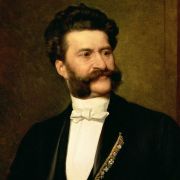
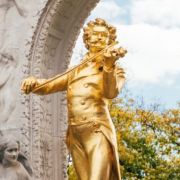
As an encore, Johann Strauss II’s Roses from the South offered a final return to that gone world of ritual, courtesy and elegance. Played with effortless grace and charm, the waltz somehow carried a deep autumnal melancholy, like a sunset of incomparable beauty that nonetheless signals the approach of dusk, sending the audience home with a smile tinged by fragile historical memory.
This concert was promoted by DK Deutsche Klassik