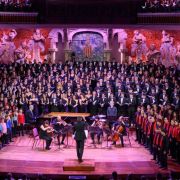
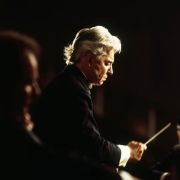
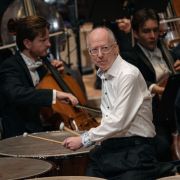
The Elbphilharmonie has achieved something that many international concert halls would find difficult to even imagine: filling a venue to over 90% for a programme consisting of demanding contemporary music. The timing is profound: 2026 marks the centenary of Hans Werner Henze’s birth. Vladimir Jurowski and the Rundfunk-Sinfonieorchester Berlin brought an intellectually fierce programme with an unmistakable intention to explore the human condition. Beyond such vast philosophical threads, what truly convinced the audience was the sheer brilliance of the musical execution itself.

The concert opened with Beethoven’s Leonore Overture no. 1. Jurowski’s reading was characterised by clean, incisive articulation and non-vibrato strings. This approach evoked a Gluck-like neoclassical idiom; in the central sections, even the most basic ascending scalar passages felt profoundly substantive, creating a vivid sense of vertical, structural clarity that mirrored Leonore’s desperate ascent from the dungeon. Brahms’s Schicksalslied seamlessly extended this interpretive path. Driven by fluid, light phrasing, the performance avoided excessive sentimentality, sounding less like a tragedy and more like an early-autumn introspection – a brief, reflective pause on the human mortality. The Rundfunkchor Berlin delivered an intimate, poetic reading that unfolded in delicate layers. The transition from the floating serenity of the gods into the restless, human torrent felt unpretentious and utterly sincere.


Where Beethoven imagined escape and Brahms charted the distance between human and divine, Henze's Ninth Symphony refuses both consolations, offering instead the unmediated testimony of those for whom neither came. In this monumental 1997 choral work, based on Anna Seghers's anti-fascist novel Das siebte Kreuz, Jurowski and the RSB delivered not through superficial word-painting, but with a high-fidelity directness and psychological intensity that laid bare its world of distortion.
The music began with the panicked, breathless vocal lines of Die Flucht, fighting against a violent and tense orchestral accompaniment. In Bei den Toten, a clear sense of mystery first came from the low strings, mixed with unsettling woodwinds and the icy chill of the keyboard. After a deceptive opening of tender strings in Die Platane spricht, the choir and orchestra plunged back into then aggressive confrontation.

Der Sturz unleashed a truly grotesque storm scene. Following the piercing shrieks of the celesta and whistling, Henze introduces a sublime, slow elegy reminiscent of Henryk Górecki’s simplicity, which gradually sharpens into a piercing edge. During this transition, a small group of the choir quietly moved upstairs to portray the ‘Saints’. This spatial separation became the focal point of the monumental sixth movement, Nachts im Dom. Set against the dark, ominous resonance of the organ – while the instrument's lighting mysteriously dimmed and brightened – the ‘Saints’ engaged in a chilling call-and-response with the main chorus. The vocal style here achieved an extraordinary effect of defamiliarisation, contrasting the repetitive, ritualistic chanting of the saints with the stark, speech-like declamations of the main choir.


The symphony finally found resolution in Die Rettung. Beginning with a serene, unified horn chorale, the musical textures regained a sense of grounded certainty. The atmosphere dissolved into a peaceful, slightly sweet tranquility, providing a hard-won solace to a devastatingly brilliant evening: perhaps not a philosophical settlement of the trauma, but an arrival at the riverbank where the pursuit finally stops.