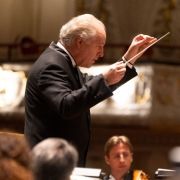
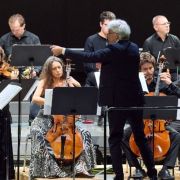
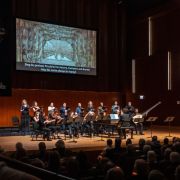
A defector, a white émigré and Shostakovich walk into an orchestral program and people act like Carnegie Hall has gifted itself to the Kremlin. While the political undertones of the Pittsburgh Symphony’s performance remained wordless, Music Director and Conductor Manfred Honeck led orchestra and audience on a distinct journey through the many costumes that truth, human emotion and dissent wear for their own survival in this world.

The concert began with the New York premiere of Lera Auerbach’s Frozen Dreams, a commission that entered the world this year, transforming a previous piece with full orchestration. The string quartet Frozen Dreams registers as moving in the same dialect as Shostakovich’s own portfolio, particularly his Eighth Quartet, and this survives as a frame to support the weighty foreboding of the additional voices. Honeck kept great control even as the piece took uncommon turns. Ultimately, Auerbach’s work leans into a sense of horror, but with beauty constantly peeking around sonic corners.


Seong-Jin Cho joined the orchestra for Rachmaninov’s Rhapsody on a Theme of Paganini, a rapid-fire Rorschach test of interpretation in which he favored and thrived in moods found on the darker end of the spectrum. While not entirely absent of levity, Cho’s variations were dominated by a complex maturity and energetic precision. Well matched, his own playing highlighted how sharp and tidily Pittsburgh’s sections can be, as if invisible walls of silence squeezed in on each note in the air.
While Cho primarily alternated moments of melancholy and viciously pointed, aggressive statements, the fun and joy came out in watching him at work. Preserving intimacy between himself and the keyboard, it sometimes seemed that he was in his own world with the sound, until he drew back to dance along with the orchestra. Even when tucked tightly into the keys, his results were expansive, as in several passages where he blended the voice of the piano so carefully that it seemed the instrument had slipped into the forest of voices behind him. He delivered an effervescent, flirtatious encore: Chopin’s Waltz in C sharp minor, played like a man making the most out of every bubble, sip and slur in a glass of Champagne, knowing it will be just the one before life summons his sobriety.

For Shostakovich’s Fifth Symphony, Honeck provided the orchestra with unornamented guidance in channeling their strengths into a performance that was as cohesive as it was compelling. Bassoon phrases were planted with clear, dedicated space, preparing the audience for how they would bloom throughout the piece. The brass section showed off expert control, dragging broad, powerful shapes down to fine, pointed whispers. When the third movement opened up the harmony, strings and woodwinds worked in turn to erect sonic architecture that felt like passing through a vaulted arch, built entirely of music.


The final movement was taken powerfully, but without sacrifice of clarity. The brass, in their triumphant boasting, were comical enough to evoke scattered laughter. Again, Honeck pulled out the contrabassoon so starkly that its low pedal notes seemed like a solo, filling the hall with a sense of judgment that one must consider that it is perhaps not the watchful eye of the State, as often interpreted, but rather the witness of eternity.
What the program lacked in spiritual transcendence, it more than made up for as a masterclass in arranging music around a thesis and arguing it with precision: somewhere between the world of Shostakovich and our own, there is an emperor strutting about in the buff, while countless others are forced to hide the best parts of themselves. Under Honeck’s steady hand, the orchestra demonstrated with certainty that emotional disobedience, the refusal of the heart, is a real and admirable thing.