Conspicuous by their absence, visual and extra-musical elements connected in various ways in all three works heard at Liverpool’s Tung Auditorium in a compelling concert of new music and contemporary classics.

Concerts celebrating Steve Reich’s 90th birthday this year have already thrown up some interesting programme combinations, ranging from Lutosławski and Greenwood at Manchester’s Bridgwater Hall to Kate Bush and Anna Thorvaldsdottir at London’s Kings Place. This evening’s concert began with a work partly inspired by Reich. Receiving its UK premiere, Josephine Stephenson’s evocative 16-minute In Time Like Air, for large ensemble, takes its title from a poem by May Sarton, where salt becomes a metaphor for life’s transience and impermanence. Such fleeting impressions are vividly captured in Stephenson’s four-movement composition. Like a soundtrack to an absent film, an undulating twelve-note motif circles in the first movement, passing back and forth between two pianos and cushioned with delicate lines on strings, woodwinds and brass. Constantly eluding one’s grasp, these swirling lines exude a mellifluous modal quality that recalls Reich.


The second movement takes on a more solid form, bound together by a repeating note in piano and percussion. A driving, bouncing rhythmic figure in the third yields ricochet-like exchanges, while the final movement begins and ends with a plangent Copland-esque chorale-like theme that suggests the opening from Reich’s City Life. Stephenson’s voice is very much her own, however, and if In Time Like Air is anything to go by, here is a composer on the cusp of something very special.
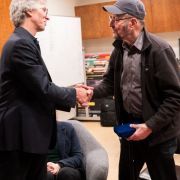
In certain respects, the evening nevertheless belonged to clarinettist Mark Simpson’s showstopping performance of John Adams’ Gnarly Buttons. The only slip Simpson made was when he almost skidded into principal violinist Thelma Handy as he arrived onto the stage to shake her hand.
In a curious way, Simpson’s entrance set the mood, as Adams has described his music as inhabiting either ‘trickster’ or ‘serious’ personalities. Some of the composer’s most effective pieces partake of both, as heard in this concerto for clarinet and small orchestra. One of Adams’ most autobiographical and stylistically eclectic works, Gnarly Buttons’ first movement (The Perilous Shore) opens earnestly with a Stravinskian reimagination of a 19th-century Protestant hymn. Trickster elements take over in the quirky dance-like second movement (Hoedown), where a subverted twelve-bar blues rubs shoulders with rapid cartoon-like exchanges. A mooing cow adds to the movement’s jocularity. A more sincere tone reappears in the song-like final movement (Put Your Loving Arms Around Me), whose graceful lyricism gives way to a powerful and dramatic conclusion.

Simpson’s interpretation was every bit as convincing as Michael Collins’ 1998 recording. Supported with precision by Ensemble 10:10 and conductor George Jackson’s unerring timekeeping, their performance captured Adams’ trickster and serious elements with poise, passion and conviction.


Completed in 2018, Reich/Richter stands alone in Reich’s oeuvre in being his only composition written with film projection in mind. The 30-minute work’s visual stimulus came from the composer’s association with painter Gerhard Richter, whose 2016 Patterns exhibition had an infinite number of images generated from a single painting through a process of multiple copying, folding and mirroring, yielding a rich array of fractal and geometrical shapes.
In the hands of a lesser composer, this mathematical approach may well have yielded a dry, cerebral, carbon-copy of Richter’s technique, but in Reich’s case, the result is a profound work that exudes a detached, intangible beauty. Reich’s use of the piece’s basic pulse (crotchet = 100) to augment its undulating, almost Baroque-like, contours and patterns, so that by the composition’s three-quarter point, the music has taken on a floating, disembodied quality before returning with a bang. Untethered from Corinna Belz’s original film, this standalone performance demonstrated that Reich/Richter can work just as effectively when performed without the visuals.