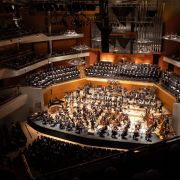
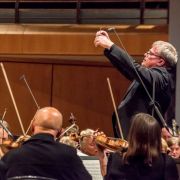
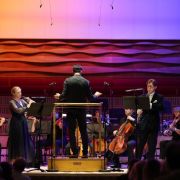
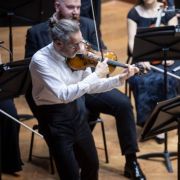
The Hallé’s latest concert under Principal Conductor Kahchun Wong began with a stately, uplifting account of the overture to Wagner’s Tannhäuser. It was, however, the two very different concertos that formed the remainder of of the programme that provided the main substance of the concert. The performances of both were superb.

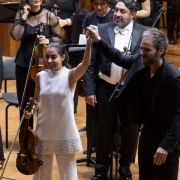
The soloist in Brahms’ Violin Concerto in D major was the renowned Viktoria Mullova. In the course of this performance it became clear that her high reputation is well-deserved. The concerto begins with an orchestral exposition; Mullova faced the orchestra with her back to the audience, as if to defer to her colleagues until it was her turn to join in. She began the second movement in similar fashion while the oboist was the focus of attention with his beautiful melody. When she did join in, though, it was stunning. The sound she created was breathtakingly beautiful. Throughout the long first movement she led proceedings, varying from contemplative to dramatic, now contrasting with the orchestra, now combining with it. The virtuosity of her cadenza was never mere show, rather it was deeply expressive; even more stunning was the gently playing with the orchestra that followed it. Wong ensured that the Hallé never overpowered the soloist, making for a really collaborative performance.


In the Adagio, Mullova was rather self-effacing, often blending with the orchestra to create a warm glow. Then the finale gave her and the orchestra the opportunity to display much more energy with its vigorous Hungarian gypsy themes. Again her beautiful tone was to the fore; an unforgettable performance.
The second part of the concert was devoted to Bartók’s Concerto for Orchestra. The unusual title suggests that the individual instruments are treated as soloists in their own right. Thus in contrast with the Brahms in which the spotlight was on Mullova with the orchestra acting largely as a homogeneous whole, the focus now fell on the individual players or groups of players within the orchestra. Wong maintained the balance between those individual performers and the orchestra as a whole. The Concerto was one of Bartók’s last works, written when he was convalescing from serious ill-health. The abrasiveness of his early works had been tempered but there remained hints of unusual folk harmonies, some suggestions of oriental music and the Hungarian gypsy music that was so prominent in the finale of the Brahms concerto. This, along with a huge variety of moods and a good deal of humour, have made the Concerto one of the composer’s most popular and most frequently performed works.

The Concerto for Orchestra is a virtuoso showpiece for a fine orchestra and the Hallé appeared to be enjoying every minute. They moved from the atmospheric opening to the triumphant conclusion, taking in everything in between. The “game of the couples” in particular showed off the skill of the orchestra as pairs of players presented their own tunes, beginning with the bassoons and then moving round the orchestra. There was plenty of humour, too in the “interrupted intermezzo” of the fourth movement where swooping strings contrasted with jaunty folk-inspired tunes and raucous brass. The central Elegia, however, presented something much more sinister, where a pleasant quiet theme could imperceptibly transform into something menacing, with a few echoes of Bartók’s early Bluebeard’s Castle. The Hallé captured every nuance and communicated the huge range of music – a fine orchestra of soloists indeed.