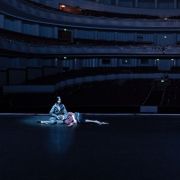
The Metropolitan Opera opened its 141st season with a new production of Macbeth, Giuseppe Verdi’s adaptation of Shakespeare’s definitive exploration of unchecked ambition. For her company debut, director Louisa Proske, co-founder of Heartbeat Opera, a New York-based company known for its boldly innovative adaptations of classical masterworks, has created a grim, psychologically driven, post-apocalyptic wasteland.

Replete with bombed-out concrete walls, piles of rubble, smoldering funeral pyres and waves of Scottish mist, Jon Bausor’s revolving set design blends traditional Elizabethan imagery with modernistic elements and makes efficient use of the Met’s slowly moving turntable, to smoothly transition from one claustrophobic scene to another. The sinister shadows cast by Adam Silverman’s lighting design enhance the mysterious, menacing atmosphere. Montana Levi Blanco’s mostly grayish costume designs, interspersed with vivid blood stains and Lady Macbeth’s lavish gowns, are equally adept at depicting a harsh and chaotic world.


Within this rotting landscape, Quinn Kelsey, who proved himself a masterful Verdian baritone in recent Met productions of Aida and Rigoletto, brought unmistakable authority to the title role. With his highly refined tone, magnetic stage presence and his remarkable ability to project emotional vulnerability, he created a brilliant portrayal of the weak general dominated by his strong-minded wife, marking a new milestone in his Met career. Singing throughout with unfailing taste, subtlety and imagination, he offered two standout moments that showcased his dramatic commitment and tremendous vocal control.

In his pivotal Act 1 dagger soliloquy, in which he is emboldened to carry out the murder of King Duncan but is afterwards filled with horror, his sound skillfully transitioned from a wonderfully soft piano to a powerful forte, reflecting his character’s increasing madness and hesitancy. In the banquet scene, his increasingly jagged and staccato-like phrasing mirrored Macbeth’s rapidly deteriorating mental state as he climbed up on a table and attacked a roasted boar which he perceived to be the ghost of Banquo, his murdered comrade.
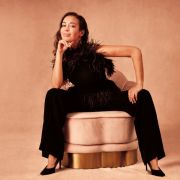
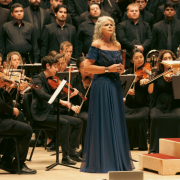
Lise Davidsen’s highly anticipated stage role debut as the manipulative, power hungry Lady Macbeth was somewhat disappointing. While her gorgeous dramatic soprano was in peak vocal form and her singing included several thrilling moments, her acting failed to completely capture the bloodthirsty ruthlessness of an ambitious woman descending into madness. Sounding underpowered and dramatically hesitant in the earlier parts of the score, she made a stronger impact in the later, darker moments. The highlight of her performance was “Una macchia è qui tuttora”, the deeply haunting sleepwalking scene in Act 4, where her vocal production was thrilling.


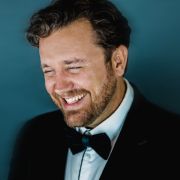
While the Macbeths dominate the stage for most of the opera, several important moments belong to the secondary cast and the ensemble. As Banquo, Macbeth’s loyal general who becomes his victim, American bass-baritone Ryan Speedo Green was a subdued vocal and dramatic presence, but one who brought the necessary paternal warmth to his warnings about the witches’ prophecies. As the Scottish nobleman Macduff, who rallies the forces and kills Macbeth, British tenor Freddie De Tommaso had only one aria, “Ah, la paterna mano”, but coming just after his character learns that his wife and children have been killed, it served as the emotional center of Act 4. Sung with anguished intensity and exquisitely lyrical tone, his heartbreaking rendition provided some of the most impressive singing of the evening.
Instead of appearing in several isolated scenes, under Proske’s direction the core group of twelve witches – at times supplemented by dancers and chorus members – was a constant presence on the stage. Climbing over walls, emerging out of cracks, surveying the action from various vantage points, they are fully integrated into the story, their consistently uniform and demonic singing adding an especially chilling note to the evening.

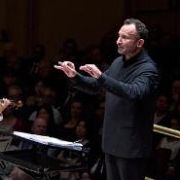
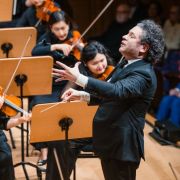
Tilman Michael’s marvelous Met choristers made the most of their many moments. As the Scottish refugees, their precise, intensely sorrowful rendition of the famous chorus, “Patria oppressa” was an emotional high point of the evening. Under Yannick Nézet-Séguin’s baton, the magnificent Met Orchestra delivered an energetic and passionate performance, completely capturing the drama and supernatural colors embedded in Verdi’s darkly atmospheric score.