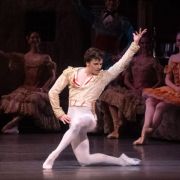
Martha Graham’s Dance Company turns 100 this year. Yet when I was watching her works last night, what struck me was how timeless her opus is. Appalachian Springs, Chronicle and Diversion of Angels evokes feelings because they are compelling, well-crafted and have a strong creative voice.

The first work on the program was the evergreen slice of Americana that is Appalachian Springs (1944). Appalachian Springs is actually unusual for Graham in that there is no darkness, no mythical struggle. It is a tribute to the optimism and ruggedness of the American frontier. It is very typical of the World War II zeitgeist, when loving America was not only patriotic, but cool. Jerome Robbins’ Fancy Free, Rodgers and Hammerstein’s Oklahoma!, the John Wayne Westerns, are works from that era under the same umbrella.
Aaron Copland’s score and Isamu Noguchi’s set have become so iconic that it’s always useful to actually revisit the cleverness of Graham’s choreography. The “chicken dance” of the Followers (four women) has wit and humor that belie Graham’s usually dignified presentation. I love the Husband’s solo with its playful kicks and hops. Just as delightful is the long solo from the Bride who mimes her future as she cradles a baby and sits on a rocking chair. And few images are as inspiring as the Husband and Bride sitting together at the end of the ballet, with the Bride’s arms outstretched towards the future.


The current company members dance Appalachian Spring well, but maybe without the overpowering charisma I imagine Martha Graham (Bride) and Merce Cunningham (Preacher) might have brought to the role. Anne Souder was sweet and hopeful as the Bride, Lloyd Knight gave off wholesome Captain America vibes as the Husband. Jai Perez didn’t quite have the explosive, direction-changing jumps that were a Cunningham trademark, but he was excellent. And Ane Arrietta was wise and maternal as the Pioneering Woman.

Chronicle (1936) is another slice of pre-World War II Americana, albeit with a different feel. The ballet is obviously a stand against oppression/Facism/Nazis. It starts with one woman doing a lament with drums and a shroud. The incredible Leslie Andrea Williams danced the solo. It is a prototypical Martha Graham solo, with the deep backbends, the extravagant raising of the leg in developpé, with the woman not just as a woman but a force of nature. Williams was larger-than-life, commanding, emotive, with an extremely flexible back and hips. Basically everything Graham was so famous for.

Eventually, the woman acquires an army with a general (Laura Dalley Smith). And oh how thrilling that army is! They march, jump and stomp in a ‘Pledge to the Future’. Williams has returned to rally the troops. It is absolutely thrilling to watch. Wallingford Riegger’s score is at times too on the nose, too “I am Woman, Hear Me Roar!” But it fits the theme of the piece. I loved it.


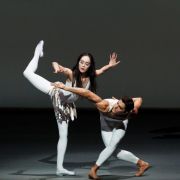
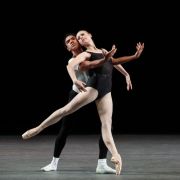
The program ended with Diversion of Angels (1948). Since this ballet premiered, the three color-coded romantic couples has become so over-used that it’s almost a trope. But I can’t think of any work that so captured the bliss of romantic love in its different forms: white representing mature love, red erotic love and yellow adolescent love.

You can see echoes of Diversion of Angels in other works. The yellow couple’s running and scampering, as well as the earth toned ensemble, would be referenced in Paul Taylor’s Esplanade. Taylor started out as a Graham company dancer. The twirling lift, with the woman’s body being held out almost like a bow, has become an ice dance staple (the “rotational lift” is now a required element). And the sculptural feel of many of the Woman in White’s poses would become a favorite motif for Alvin Ailey.
I know it seems that I’m just gushing about the performance, but Martha Graham’s genius and Janet Elber’s stewardship of the company into the 21st century deserve to be celebrated, loudly. And here’s to another 100 years.