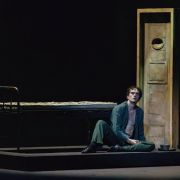
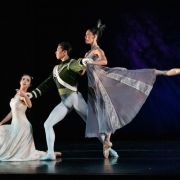
Cuba’s spirited Malpaso Dance Company reached New York last week against formidable geopolitical odds. Flights are scarce amid the island nation’s economic free fall – accelerated by Donald Trump’s restrictions on Venezuelan oil – and visas rarer still amid a hardening American border posture.

Astonishingly, Malpaso (ironically, “misstep” in Spanish) arrived with live music: Havana’s all-female Alma String Quartet and Brooklyn-based trumpeter Adam O’Farrill with his ensemble Stranger Days. The small but mighty Joyce Theater crammed one band into a forward area of the stalls at house left, the other at house right. And what glorious music they produced.
Mexican Modernist Carlos Chávez composed the score for Martha Graham’s Dark Meadow in 1946, later excerpted as the Dark Meadow Suite – Malpaso’s first venture into the Graham repertory. Spare rhythmic gestures braided with lush strings to create a mesmerizing soundscape. The dance unfolded as a cool sculpting of shapes in ritualistic processions across a stage that glowed in the crimson, burnt orange, and umber of a Southwest landscape.


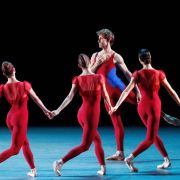
The women were sheathed in color-blocked columns, midriffs bare; the men in earth-toned briefs anchored by leather straps. With hands braced on their hips in the opening image, the women recalled amphorae. Heels pounded, hands struck thighs, driving against the music, suggesting a perilous journey. The dancers forged ahead with stark, angular movements that contrasted with the expansive rounded spaces of contracted torsos, evoking monumental landscape formations.
In the wake of the Mexican Revolution and World War II, as artists sought to forge new national identities, Chávez and Graham gestured toward a mythic origin story of the Americas, unmoored from established folklore and European inheritance.

Greta Yero, quietly magnetic, tested the ground in deep lunges before journeying solo. Esven González radiated a simmering power in slashing jumps and warrior stances. Striking lifts sent the women whirling in the air, their taut angular shapes conjuring dust storms. Couples struck a ship’s figurehead pose: women cantilevered forward, arms windblown, the men crouched behind to anchor them with a grip at the shins. At the close, Yero and González alone reprised the image, as if their comrades had succumbed to harsh conditions.
Dark Meadow Suite is a handsome and consequential addition to Malpaso’s repertory. Their command of Graham’s strenuous technique contrasted pleasingly with the looser-limbed vocabulary of Year of the Leopard, a world premiere by Keerati Jinakunwiphat. She danced with A.I.M by Kyle Abraham and has since been commissioned by New York City Ballet.

Music and costume ultimately proved more memorable than choreography that leaned on spiraling falls, snaking torsos and emphatic kicks. Amusing arms flexed and craned like waterfowl – necks rotating, heads darting and pecking. Trumpet and sax honked and ricocheted with multiphonic virtuosity while bass and drums alternately brokered peace and provoked further altercations. Stranger Days spun a sonic fabric as alluring as the loose, silky tunics layered over knee-length skirts, which sent swirls of lemon, orange, and leafy green through the air.


Couples snapped into a slow dance only to decouple moments later. Esteban Aguilar delivered a finely calibrated meltdown in the final section but the cast seem to have been caught in mid-phrase when the music ended. And the leopard? Nowhere in sight – perhaps already endangered.

A sensuous, wintry sound world was created for the world premiere of La Estación, choreographed by company member and co-founder Daileidys Carrazana. Joined by keyboardist Gabriel Chakarji, the Alma Quartet tackled a striking mix of Piazzolla, Tchaikovsky, and excerpts from Max Richter’s ubiquitous reworking of The Four Seasons. Mud-toned unitards and knee pads signaled a dance of endurance, reflected in choreography that was rugged and often combative.
Couples locked in prolonged staring contests before one dancer flung their head back – at once funny and tragic. Elsewhere, bodies pulsed and twisted as arms curved around absent partners; dancers sprinted while clutching their foreheads, dragged one another across the floor, or swung a body over the shoulder. In one of many witty images, a dancer hauled himself forward on his belly while another lay draped across his back – as if sunbathing on a pool float.

The ensemble would frequently hang back, like impartial witnesses, while one or two figures struggled. Faint echoes of The Rite of Spring surfaced in Jennifer Suarez Ramos’ magnificent, writhing collapse. And of the ensemble in Carlos Saura’s Bodas de Sangre, in rehearsal for a flamenco adaptation of Lorca’s play, observing an erotic entanglement spiral toward violence.
Yet the amount of material in La Estación was overwhelming, at odds with the hypnotic minimalism of its score. Malpaso’s versatile dancers – heirs to a tradition that braided ballet and modern dance with Afro-Caribbean forms – hurled themselves into the work as if there was no tomorrow.
Alarmingly, there may not be – not only for Cuba, but for the United States as well.