Seattle Chamber Music Society’s month-long summer ritual began in the familiar place – the intimate, 536-seat Nordstrom Recital Hall inside downtown Seattle’s Benaroya Hall. Also familiar was the air of anticipation in the packed room, filled with listeners eager for the kind of high-level chamber music-making that violinist and artistic director James Ehnes continues to assemble in Seattle.

But this edition comes with an unusual number of moving parts. After the first week, summer renovations at the Benaroya mothership will send the festival into temporary exile across the region, with concerts elsewhere in the city, east across Lake Washington and even onto a couple of Puget Sound islands.
The opening programme supplied a moving part of its own. The first half originally scheduled for Alessio Bax and Orion Weiss — Rachmaninov’s Symphonic Dances — was replaced at the last minute, owing partly to travel and logistical challenges, by a motley piano-four-hands sequence of Poulenc, Schubert and Gershwin. The Rachmaninov would have offered an oblique fit for the festival’s ‘America at 250’ thread: a product of the composer’s final American years, composed in 1940 on Long Island, “very near the East and West Egg of Fitzgerald’s The Great Gatsby,” as SCMS annotator Eric Bromberger remarks.


The switch at least preserved Bax and Weiss, who shared the keyboard with comfortable rapport, giving the new sequence poise. Still, its path from Poulenc to Schubert to Gershwin inevitably felt a bit eccentric, especially since the late change left the added works without programme notes – the Poulenc and Schubert in particular could have benefited from a bit of framing.
Poulenc’s pint-sized early Sonata delivered modernism in impish, non-threatening gusts: sharply percussive attacks and saucy ostinatos in the outer movements, with a slow middle of beguiling simplicity just short of faux-naïve. The sad eloquence of Schubert’s darkly beautiful Andantino varié in B minor, D823, supplied an unexpectedly sombre turn, its French connection lying in the theme on which it is based.
Gershwin’s Rhapsody in Blue ensured that the festival’s American thread came back into view – along with another hint of Gatsby, where Fitzgerald’s “Vladimir Tostoff’s Jazz History of the World” reads like a thinly disguised wink at Gershwin’s Jazz Age calling card. Yet Henry Levine’s arrangement, published nearly two decades after the 1924 premiere, allowed the audience a fresh look under the hood. Bax, taking the secondo role, brought slinky swagger to the bass lines, while Weiss supplied flashy treble flourishes. Their unusually long-held pauses added suspense, turning Gershwin into a bench choreography of elbows, timing and contrasting temperaments.

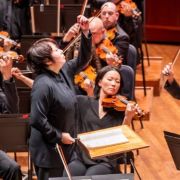
After intermission, the programme’s logic of doubling shifted timbre from piano to strings with Mendelssohn’s teenage miracle, the Octet in E flat major. Ehnes and his regular quartet colleagues – violinist Amy Schwartz Moretti, violist Che-Yen Chen and cellist Edward Arron – were joined by violinists Andrew Wan and Chad Hoopes, violist Milena Pajaro-van de Stadt and Seattle Symphony principal cellist Efe Baltacıgil in a performance that revitalised another much-loved standard through narrative thrust and spellbinding invention.


The vast first movement had genuine dramatic sweep, surging like episodes in a story with accumulating stakes. Pointed ensemble unisons flashed with electricity, and the rush of the reprise was hair-raising, yet eight distinct musical personalities still registered within the larger design. The inner movements kept the arc taut. If the Scherzo didn’t quite defy gravity with gossamer ease, its wit and pulsing charm still kept the music airborne.
Plunging into the finale with barely a breath after the Scherzo, the ensemble made its contrapuntal energy a case study in individual personalities braiding into a whole. Lines darted and overlapped, the heat passing from player to player until the whole ensemble seemed to be feeding the same flame. For all its virtuosity, the ultimate thrill came from the musicians’ palpable desire to pass that flame outward.