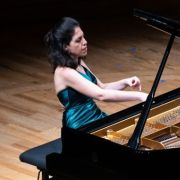
Yulianna Avdeeva opened Seattle Chamber Music Society’s Signature Series at the Illsley Ball Nordstrom Recital Hall in notably changed surroundings. Over the summer, Benaroya Hall underwent an extensive renovation of its public spaces, leaving both performance venues untouched while transforming their surrounding lobbies. The recital hall’s newly redesigned, mid-century-modern-inflected foyer is now dominated by Robert Rauschenberg’s Echo, a vast collage incorporating musical instruments, John Cage scores and images gathered around Seattle. Just over 12 feet high and nearly 45 feet long, the nine-panel mural had hung above the portals of the larger concert hall since Benaroya opened in 1998; relocated here, it can now be seen dramatically at close range.


Once inside the recital hall, attention shifted from the altered surroundings to Avdeeva’s wide-ranging program, from the lively concertante dialogue of Bach’s Italian Concerto through Beethovenian volatility to an entire second half devoted to Ravel’s increasingly unstable transformations of dance. The 2010 International Chopin Piano Competition winner’s stage manner was reserved and concentrated. While she never spoke to the audience, the recital felt intensely personal, and Avdeeva established a close rapport without needing to say a word.
In Bach’s Italian Concerto, the central Andante was especially memorable. Avdeeva kept the left-hand ostinato unobtrusively yet clearly present, while the increasingly ornamented melody above wheeled and dipped over it like a bird riding shifting currents. The outer movements had ample buoyancy and crisp contrasts.
Beethoven’s rarely heard Fantasy in G minor, Op. 77, brought out a very different side of her playing. Avdeeva emphasized its abrupt key changes and almost violent swings of mood, at moments with a touch of knowing humor that suited the work’s theatrical unpredictability. It made an intriguing prelude to her Appassionata, where any hint of playfulness gave way to sustained tragic intensity, with the Andante providing the sole respite. Avdeeva’s performance was tightly organized and serious without becoming heavy, its force coming from sharply judged accents and dynamic weight rather than keyboard battering. The finale was especially compelling, its perpetual motion accumulating pressure until the close felt not merely inevitable but genuinely, grimly tragic.


The all-Ravel second half revealed still another dimension of Avdeeva’s playing and contained some of the evening’s most compelling performances. She kept the Pavane pour une infante défunte unsullied by sentimentality, while allowing its melody to gain richness with each return against a changing harmonic background. In Valses nobles et sentimentales, Avdeeva responded keenly to the variety of character from one waltz to the next. Yet even at the music’s most sensuous, there was something intriguingly analytical, even disembodied about it, as if the flesh of the dance were gradually dissolving while the triple-meter pulse remained subliminally present.
That made La Valse a natural culmination. Avdeeva could summon enormous power from the Steinway, but the more telling effect was the sense of rhythmic momentum persisting even as the dance itself began to disintegrate. Its violent ending also invited comparison with the close of the Appassionata: two very different works in which forward motion becomes impossible to escape.
For an encore, Avdeeva stayed with the waltz genre, gifting the audience with an account of Chopin’s Waltz in A flat major, Op.42. After Ravel’s increasingly unstable dances, its more familiar elegance came as a welcome release, though Avdeeva never let the music become merely decorative, shaping it with silvery, gravity-defying runs and a finely sprung rhythmic lift.