In one of the most beautiful settings, high up in the hills above Spoleto at Rocca Albornoziana, the Festival dei Duo Mondi presented a series of performances of Marco Goecke’s Seven Ages. Commissioned as a site specific work, the performances took place in a large courtyard with frescos high on the walls. In the centre was a space for live musicians and a raised spiral platform which allowed the solo dancer to perform on or off it.

Inspired by William Shakespeare’s The Seven Ages of Man, Goecke’s instantly recognisable choreography was magnified from the start. With an original score by Kirill Richter and played live by the Richter Trio (Richter on piano, August Krepak on the cello and Jérémie Visseaux on violin), the atmosphere felt inclusive and intimate.


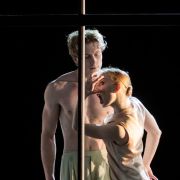
The solo was interpreted alternately by either Matteo Miccini or Anne Jung and it was Jung who took on the role when I saw it. Goecke’s distinctive take on each stage of life was remarkably clear. We pretty much felt the infant Jung emerging from the womb at the start, taking her first juddering breaths. By the time the ageing process had kicked in, she was withering and fading before our eyes.

An exquisite dancer, Jung embraced all Goecke’s quirks and jerks, frenetic hand and arm movements and distorted postures, as if it was second nature. For such a beautiful woman, it seemed a little harsh to watch her grimacing grotesquely but she was 100% invested and left an indelible impression. To see her mock shooting in the military phase, or sitting hunched over while smoking heavily as an elderly person, may have seemed incongruous but she embodied each stage of her journey. The snapping of her walking stick signalling the end of life was especially poignant. The presence of the superb Richter Trio was a huge bonus and a vital part of the performance.

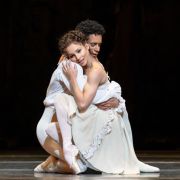
As if by contrast, two nights later at the Teatro Nuovo Gian Carlo Menotti, Benjamin Millepied’s Du bout des lèvres was given its Italian premiere. Millepied is an exceptionally musical choreographer and this resulted in a fluid, aesthetically pleasing, gently lilting work of great beauty. Inspired by the legendary French singer-songwriter, Barbara, each dance expressed a different emotion: passion, heart-break, friendship, tenderness and so on. In much the same way that Barbara’s songs seemed to come straight from the heart, so Millepied’s creation was genuinely touching and authentic.


With the women dressed in floaty tunics in muted colours (Gauchere), the stage surrounded with white, gauzy curtains (Margaux Maeght) and Lucy Carter’s inimitable lighting design, it was visually serene. I especially liked the way the dancers entered and exited the stage through the gaps in the folds of the curtains, as if stepping out of a cloud or disappearing into the ether.

The dancers were part of a dance project which Millepied has set up in Paris, each of them offering individuality and different movement quality. The piece tripped along at varied pace, each dance beautifully constructed and delivered with the utmost grace. A male duet, jolly and jokey, had a slightly syncopated rhythm, solos were saturated in melancholy or joy and a dance for two couples had a folk dance feel to it. Lifts came out of nowhere, seemingly weightless – the eight dancers waltzed through 75 minutes of highly skilled movement, making it all look effortless.
While there was no clear narrative, each song was infused with palpable, intense feelings which invariably evoked similar emotions within the viewer. It was like being part of a lovely dream where you were able to dip in and out at will. I could definitely watch this again and find still more to admire.
Deborah’s trip was funded by the Festival dei Due Mondi di Spoleto