Swan Lake has always been a benchmark of the ability to stage classical ballet, while being one of the most popular ballets in the repertoire. National Ballet of Japan’s revival of Sir Peter Wright’s version, originally created for Birmingham Royal Ballet (the production is supported by BRB), last performed in 2023, displayed emerging talents as well as the beauty of the highly-praised corps de ballet of Swans in the second and fourth acts.

Wright’s version is a dark one, focusing on the inner turmoil of Prince Siegfried. The ballet opens with the funeral of the late king, where the stage is so dimly lit that it is almost impossible to recognize who is following the coffin. It shows clearly the pressure that is cast upon the young Prince who has to lead the kingdom at a young age. He has a strong bond with his friend Benno, who seems to be the only one who truly understands him and who tries to entertain the melancholic prince.


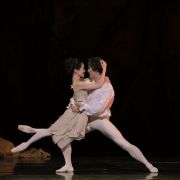
The party scene in Act 1 is in dark, heavy tones showing that the kingdom is still mourning the death of the King. At the epilogue, Benno rushes to the lake only to find his friend has drowned and he laments while carrying the lifeless body of the prince. This version seems to have a bromance factor in a home-social world, as the Pas de Quatre in the first act is danced with two Courtesans and Benno with the Prince, and his friends follow him to the lake in the second act.

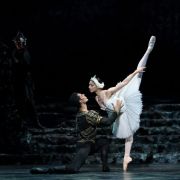
On the opening night, the dual role of Odette/Odile was performed by Ayako Ono, one of the seasoned principals. Although Ono is petite in stature and not a typical swan type ballerina, her extraordinary delicacy, musicality and accurate technique, along with her dramatic ability, has made her one of the greatest Swan Queens in Japan. At this performance, her Odette carefully told the story of the doomed fate of the Swan Princess with her lyrical arms and with the precision of her footwork. It was a spellbinding moment and Kosuke Okumura, her prince, slowly fell in love with her. He gradually unleashed his passion displaying excellent partnering skills and attention to detail. Ono was a enchanting Odile in Act 3, seductive and evil but there was a rare mishap during her fouettés in the coda.

At the beginning of Act 4, Artistic Director Miyako Yoshida announced that Ono had fallen ill and was unable to finish the performance. In the final act, she was replaced by long-limbed Akari Yoshida (who had been Odette’s vision in Act 3) and Okumura was replaced by the charismatic Shun Izawa. They managed to close the performance maintaining the tragic drama until its catastrophic ending, thus saving the evening. The whole company gave of their best to ensure that the performance continued at the very highest level.


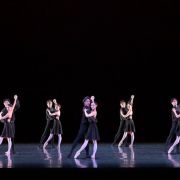
The role of Benno, who plays an important part as the Prince’s friend was performed by Yoshito Kinoshita with ardent devotion. He also danced an excellent solo in the Act 1 Pas the Quatre. Moeko Iino and Haruka Sootome were both supremely classical with strong technique as the Courtesans. In Wright’s version, the Princesses have solos in Act 3, who are potential candidates for marriage. Yui Negishi as the Polish Princess shone with her strong stage presence and soaring leaps.
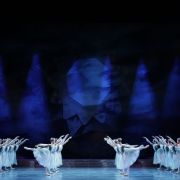
Many young artists were featured as soloists this time and showed great promise, but the mesmerising corps de ballet of Swans are the artists that deserve the highest praise. Their uniformity, the ethereal atmosphere created by 30 Swans was simply breathtaking, especially during the opening of the fourth act. As the swans rose in the mist, it was so exquisite, it has to be one of the reasons why people are so attracted to this ballet.

Tokyo Philharmonic Orchestra under the baton of conductor Paul Murphy played Tchaikovsky’s iconic score impeccably well, and the harp solo was especially memorable for its beauty. With elaborate, luxurious costumes and ornate sets, especially in Act 3 (Phillip Prowse), the whole production was a delight for both eyes and ears.