It seems to be getting more difficult to perform Petipa’s traditional Raymonda these days because it has been criticised for its orientalist stereotypes, set in the age of crusades. Ballet companies in the west are now regularly creating new versions of the ballet with reimagined plots.

National Ballet of Japan’s (NBJ) version of Raymonda premiered in 2004, choreographed by the late Asami Maki, it is a lavish, exquisite production and often described as a gem in the company’s repertoire. Miyako Yoshida, the current artistic director, had considered bringing this production when the company toured to London, but it was decided that it was too risky to perform this traditional version for audiences in Europe. Nevertheless, the production’s beauty has not faded and has continued to enchant audiences in Tokyo.

Although Maki’s choreography follows the original Petipa version, she made some alterations to the plot. The ballet opens with the secret betrothal of Raymonda and her fiancé Jean de Brienne before he departs on his crusade, while her admirer, the Saracen knight Abderachman watches them from a distance. Maki’s point was to show that this is a love story; Abderachman is not a barbaric warrior, he is just a passionate nobleman with dignity who is in love with Raymonda. It is unfortunate that Raymonda already has a fiancé whom she is in love with. Maki had aimed to make the story less of the east meets west clash of culture by diminishing the tone of exoticism, but some traces remain.


When the curtain rose, the audience was immediately stunned by the refined shades of blue and gold in the backdrop and lush, delicately crafted costumes, designed by Luisa Spinatelli, alongside lighting design by Yuji Sawada. This magnificent production is a jewel in the NBJ crown and seeing the set alone is a breathtaking experience, like the feeling of opening a picture book about a medieval knight’s tale. The narrative of Raymonda is rather thin, but there is plenty of good quality dancing for the main protagonists and the corps de ballet, which is sheer joy for dance lovers, along with Glazunov’s dazzling score.

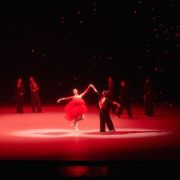
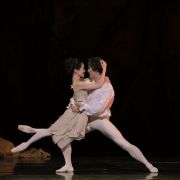
The role of Raymonda is tough, with five variations, three of which are in the first act, so the ballerina needs stamina as well as technique and musicality. Yui Yonezawa, as the opening night Raymonda, has it all. Her lyrical Fantasie solo in Act 1 was ethereal, using her whole body softly, serenely and perfectly controlled. Her pointe work was neat and crisp in the second act solo and the Hungarian solo in the third act was regal with delicate bourrées and the characteristic dramatic upper body movement. Everyone in the house held their breath whilst watching her. One could see how Raymonda had matured throughout the ballet, from an innocent young girl to a noble woman; through experiencing a duel played out in front of her, a man prepared to sacrifice his life for the sake of her love. Yonezawa is undoubtedly one of the most accomplished ballerinas of our era.

Yudai Fukuoka had the dashing technique, the airy leaps and masculine bravura that embodies Jean de Brienne, while also displaying good partnering skills. Takuro Watanabe is still a young first artist who made his debut as Abderachman as a result of replacing an injured dancer. He had a strong stage presence combined with the dignity of a proud Saracen commander, experiencing unrequited passion which did not move Raymonda, but left a thorn in her heart.


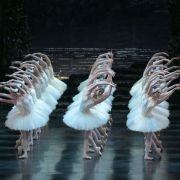
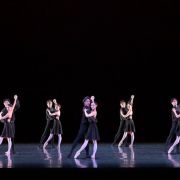
Raymonda has plenty of dancing, not only for the soloists but also for the corps de ballet. The Fantasie scene’s corps were breathtaking. There were plenty of synchronised arabesques reminiscent of Giselle Act 2 Wilis, character dances in Act 2, and the gorgeous Grand Pas Classique Hongrois. The quality of those dances has improved greatly since the recent revival in 2021. In the numerous soloist roles, it was good to see many of them were danced by role debuting young talents such as Maho Higashi who danced Clemence. This gives us hope that the company are nurturing those budding artists that may go on to dance the main roles in the future. The production is a good vehicle for growth with so many enchanting but challenging classical variations. Although performing the traditional Raymonda has become controversial, the magnificent Glazunov score (played this time by Tokyo Philharmonic Orchestra), stunning production design and the rich choreography should be kept in the repertoire, even though slight alterations might be necessary in the future.