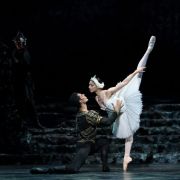
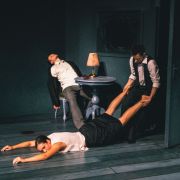
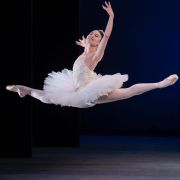
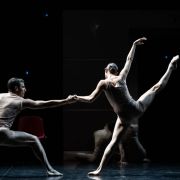
This February, Holland Dance Festival made its biennial return. Welcoming acclaimed choreographers and dance companies from around the world, this international dance festival showcases the very best in dance in various theatres in the Netherlands.

For this milestone 20th jubilee edition, renowned choreographer Hofesh Shechter presented his latest piece, Theatre of Dreams to a full house at the Amare Danstheater in the Hague. The recent recipient of Chevalier des Ordre des Arts et Lettres by the French Ministry of Arts and Culture, Shechter is no stranger to the Dutch dance scene, having created one of his most recognizable works, Clowns, on Nederlands Dans Theater ten years ago.
Theatre of Dreams presents Shechter’s own Hofesh Shechter Company to Dutch dance audiences. It’s an impressive work of dance theatre that contemplates the mysteries of dream states, at times provoking and enticing the audience to engage with the work in dynamic ways.


This is apparent at the beginning of the piece, as people enter the auditorium perfumed in a light mist. The din from spectators holding conversations or slowly finding their seats transforms into a low murmur as a man approaches the stage from the audience. Staring at the curtain before him, the man jumps onto the stage as the audience settles into silence. A rhythmic composition slowly emerges but remains muted, as though coming from a distant, far off place. The man finds a small entry point at the base of the curtain and both he and the audience enter the theatre of dreams, an almost 90-minute dreamscape of episodic dance scenes, constantly unfolding and revealing itself through layers of shifting curtains that the dancers themselves manipulate.
The use of black curtains in conjunction with the incredible lighting design by Tom Visser is one of the most innovative and breathtaking features of Theatre of Dreams. The company, made of twelve virtuosic dance artists, are in constant motion throughout, shifting various panels of curtain that engages the audience to look upon unfolding dance moments. Curtains are pulled open to reveal yet more layers of curtains. The spectators gaze even deeper until another set of curtains opens slightly, exposing a sliver of piercing light that reveals a small cluster of dancers bumping, grinding and embracing.

The whirling curtains and dramatic lighting present different propositions in a blink of an eye (much credit to the stage manager whose lighting cues alone are truly a technical choreographic feat). Throughout the piece, both the curtains and lighting frame the action. At one moment a cluster of dancers are in an orgiastic frenzy when the lights swiftly turn on and off and, as if by magic, a new scene emerges with a new set of dancers embodying a new sequence of emotions.
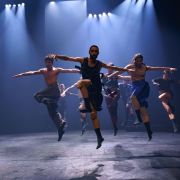
Just as the set design and lighting activates the audience to engage with various dance happenings in different configurations on the stage, Shechter’s signature dance language is equally as captivating. With barely any pauses, the ensemble dances with a possessed passion, undulating between twitchy spasms and traditional folk movements with lyrical swagger.


Part of Shechter’s impressiveness is his talent for composing original music for his work which often layers atmospheric vocal distortions with electronic techno beats and percussive rhythms. This, paired with his “more-is-more” movement aesthetic creates dancing that looks both sensually physical and tactile. In collaboration with Yaron Eagler, Theatre of Dreams also includes a live music element, bringing a trio of musicians – Eagler, alongside James Keane and Alex Paton – onto the stage to interact with the dancers, anchoring the theatre of dreams into separate acts. Without giving too much away, a particular Bossa Nova infused section is especially moving for both dancers and audiences alike.

While most would agree that Shechter’s theatrical investigation of dreams is a sumptuous smorgasbord of dance theatre rich in visual imagery, one could also say it is a direct hit on the senses. Theatre of Dreams is a David Lynchian dancescape of riddles wrapped in enigmas: is this a fantasy or a nightmare? A false memory or an alternative reality? A dance club or commune? As always, Shechter masterfully sustains this dream-like state which borders on excess and dopamine overload. Leaving the Amare to catch my train, I felt both mystified and moved by what I had just witnessed. Like most dreams, upon waking up, sometimes they’re hard to process and a challenge to interpret. However, the best ones, as with Theatre of Dreams, tend to linger in one’s imagination indefinitely.