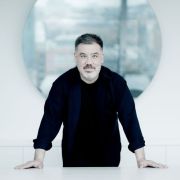
Whether by conscious design or happy coincidence, it felt entirely fitting that one day after the Fourth of July, the Hamburg audience welcomed an American violinist alongside what is arguably the most famous symphony ever premiered on American soil. At first glance, this subscription season finale of the Philharmonisches Staatsorchester Hamburg seemed to promise only a pair of overplayed repertoire staples. Yet, the sheer ambition and adventurous spirit of conductor Omer Meir Wellber successfully infused the entire evening with an undeniable sense of freshness.

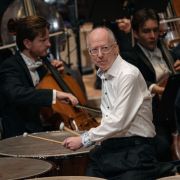
The first half featured a fascinating (re)construction of Bruch’s First Violin Concerto, boldly replacing the original opening movement with Barbara Assiginaak’s newly commissioned Niibaashkaa – Travels at Night. Envisioned as a metaphysical time traveller staging an imaginary conversation with Bruch, the work refused to be overshadowed, avoiding direct thematic extraction. Instead, its musical atmosphere was entirely self-contained, characterized by a captivating lyricism sustained over a rustling texture in the strings. The percussion section further heightened this organic aura by subtly evoking the rustle of wind. Much like Marguerite Yourcenar’s Memoirs of Hadrian, the new work carried a deeply private intimacy, rich with imaginative details that allowed it to engage in an equal, luminous dialogue with a canon.


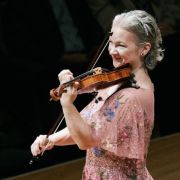
Hilary Hahn performed this 15-minute movement with exceptional calmness and sensitivity, her breath perfectly synchronized with the orchestra. The musical elements remained pure and concentrated, moving at a steady, unhurried pace. Just before transitioning into Bruch’s second movement, the music suddenly introduced rapid passages and new ideas. Here, Assiginaak playfully teased the audience, making it seem as though this new piece was about to evolve into a "concerto within a concerto" by entering its own second movement.
Instead, Bruch’s original, lyrical Adagio seamlessly commenced. Hahn rendered it with immense warmth and singing quality, remaining rigorously self-controlled and utterly devoid of calculated sentimentality. In the Finale, her playing exploded with rhythmic tension and heartfelt vitality, characterized by a bright and full-bodied tone. Following enthusiastic applause, her Bach encores offered a stark, intimate contrast – filled with deeply personal contemplation and marked by a mature control of timbre.

In the second half, Dvořák’s Symphony no. 9 was demonstrated in an exceedingly radical, risk-taking interpretation that left the audience exhilarated through-out. Wellber’s conducting gestures were remarkably fierce and tremor-like, strikingly reminiscent of Wilhelm Furtwängler’s legendary 1948 London rehearsal footage of Brahms’s Fourth Symphony finale. The orchestra unleashed an unparalleled density of energy, marked by massive rubato shifts and a tempo significantly faster than what is usually heard. Wellber stripped the work of Romantic indulgence, imposing a lean, muscular and relentlessly swift momentum. The strings minimized their vibrato, favoring an electrifying clarity of articulation, while the woodwinds and brass played with alert, high-spirited precision.


The performance surged forward from the high-tension Adagio of the first movement to the expansive development of the main themes. The famous Largo flowed at a fluent, forward-moving pace, steering clear of nostalgia, while the Scherzo crackled with sparks of pure energy. In the final movement, Wellber brilliantly adjusted the sonic architecture, sometimes reordering the balance of priority between the brass and string sections to offer an entirely new acoustic experience. Throughout these 40 minutes, one was left with the recurring illusion that what they were listening to was more of a Mahlerian volcano in mid-eruption, truly exposing the uncharted territory of a "New World".