It speaks to the ethos of Wet Ink Ensemble that their season opener at Zürcher Gallery in Manhattan’s East Village was introduced as a concert of “works in progress” (although not advertised as such). Their very name suggests a score so fresh it’s not yet dry. Three of the four pieces on this night were world premieres and all composed by ensemble members.

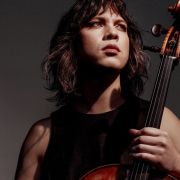
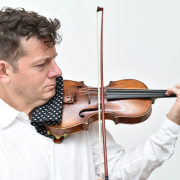
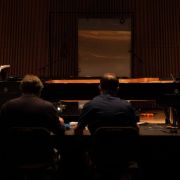
It also suggests something particular about Sam Pluta, the group’s master of electronic manipulation, that his Sixty Cycles C heard in its New York premiere while still in development, and will be heard again at the ensemble’s ‘mini festival’ in December with different instrumentation. Sixty Cycles opened the night, a drone with extended tones stacked atop by saxophonist and founder Alex Mincek sitting next to Pluta’s and violinist Modney standing off to the side. Among the cables and gear were two monitors affixed with contact mics and displaying interference patterns matching the shifting electronic sound bed. After several minutes, the electronics receded for a few placid moments, shifting the perspective. The tenor sax – sustained notes in the lower register – melded with the synthesized tone, amplified string noise complementing the disruption. At some length, cellist Mariel Roberts Musa took her seat, Modney claimed his chair, and the purity of the strings marked the conclusion.


Mincek’s Constellations Traced Across Grids started in even softer whispers from sax and strings in harmonic intervals. It wasn't slow, it was still for several minutes before a jazzy trio outburst of no more than four bars, submerging then with a sort of dial-tone foundation. They cycled through the structure again, the second outburst with a bit of a bluegrass feel. The quietude returned slightly fuller, slightly more complex, bearing some similarity to the compositions of fellow saxophonist Roscoe Mitchell. (It Is likely coincidence but worth noting that Mincek teaches at Northwestern University, a commuter train away from the city that gave Mitchell's Art Ensemble of Chicago its name.)
Roberts Musa made great use of the quartet’s possibilities. Her Rhizome suggested cello and violin raindrops, with electronic and sax flutters building quite nicely like an incoming front – or the expanding root structures of the title. The saxophone again leaned into jazz hollers; Mincek is not always a fiery soloist but he's not afraid to go there. As the solo escalated, the strings dropped out and sax and electronics heightened. The second half brought unexpectedly warm and pleasing melodies.
The mono-named Modney has been active in recent years in the ever blurrier demilitarized zone between composition and improvisation in New York City. His Ballads/Striations, in both graphic and traditional notation, started with a hard viola solo, improvised or otherwise. The soft entrance of cello held the promise of quieting but, after a very brief pause, the full quartet executed high drama: romantic and moody, escalating into cinematic cyber noir. Whether or not it was music about improvised solos, it gave each of the four their own spotlight, as it for a few minutes each in turn was responsible for maintaining the energy of the whole, before coming to a slow, beautiful, wavering, discordant conclusion.


Wet Ink seems always to be in flux. They’re a flexible octet with a concomitant large ensemble, a collaborative and commissioning group and a presenting organization. In this subset of the octet – with bright lights bouncing off the walls of the Bleecker Street gallery, between shows and so leaving an expanse of white – they were a subdivided powerhouse.