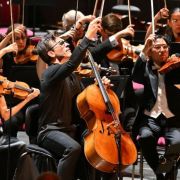
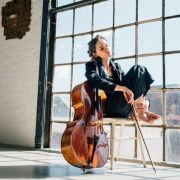
“I remember my first contact with the Schumann Cello Concerto was through the recording by Casals,” reminisces Italian cellist Mario Brunello. If ever a cello concerto presented plenty to discuss for a period performance specialist such as Brunello then it’s this one. Robert Schumann’s first and only orchestra-accompanied work for cello, the concerto presents its soloist lyrically and centre-stage, the orchestra mostly scored sparingly and operating deferentially. A traditional Romantic-style tussle between heroic soloist and feisty orchestra it is not.

Brunello is to perform the concerto in November in Paris, at La Seine Musicale with Insula orchestra, the period-instrument ensemble founded and conducted by Laurence Equilbey. Schumann’s initial draft dates from 1850, the year after the composer’s success with his very first duo work specifically for cello, the Fünf Stücke im Volkston. As with those five piano-accompanied pieces in folk style, the concerto is primarily lyrical rather than over-dramatic. Further originalities include its modest length (indeed Schumann originally titled it ‘Konzertstück’ rather than ‘concerto’) and its lack of breaks between movements, the three instead running seamlessly from one to the next.
Back to Brunello and his vinyl of Casals in 1953 with the Prades Festival Orchestra under Eugene Ormandy. Those seamlessly running movements didn’t prevent him, when still a young a cello student, from being so moved by the slow central movement – despite the poor sound quality of the recording itself. “The capturing of the orchestra is not so good,” Brunello comments. “It sounds as though their instruments are made of metal. But I found the second movement so touching that I liked to listen to it as a first, setting the needle down initially in the middle of the record.”
This Langsam movement over, Brunello would then play the opening movement, and no less delightedly. “I so liked the noise of Casals’ left hand on the fingerboard,” he remembers with warmth. “Most especially, there is one point where his hand has to make a big jump, and he knocks the fingerboard – and I would spend the entire first movement anticipating that moment, because it was so human that even this great cellist – the world’s greatest cellist – had to be careful with technique in this concerto.”


Appropriately enough, Brunello’s other strong early memory of coming to know the concerto through Casals is a performance practice-themed one: namely, that while Schumann’s original cadenza is a brief, unshowy, and lightly coloured by orchestral chords, Casals used to add a longer one. “Perhaps at that time they didn’t think that it was long enough” muses Brunello, before pointing out that another luminary cellist, Rostropovich, was so dissatisfied with the balance and shadowy quiet of Schumann’s score that he commissioned Shostakovich to pen a heavier and brighter revision, adding instruments and thrust to the orchestral writing, matched by a more forceful solo part. Brunello in fact performed that 1963 revision just last year with the London Symphony Orchestra and Sir Antonio Pappano, but while he finds Rostropovich’s dissatisfaction with Schumann’s original score fascinating, at La Seine Musicale it will be Schumann’s score on everyone’s music stands – and rightly so, he emphasises.
“It’s a perfect concerto” he states, “but every cellist, every musician, every conductor who has played it wanted to put something more in this music. And I understand why, but I think that we have to really look inside this music, because everything is there.” Including, he continues, the freedom that Schumann gives his soloist from first note to last. “With the other big romantic concertos you can choose a different way, but only for a certain moment in the piece,” he outlines. “Whereas Schumann allows for any number of different ways, even a more rhapsodic or rhythmic approach, and for you then to continue in that vein. It’s a free journey.”

So to now have the prospect of diving into this freedom via a first-ever collaboration with Equilbey and Insula orchestra – and to not only look deep into Schumann’s score, but do so within the sort of gut-stringed, period-instrument sound world that Schumann would have been hearing in his head as he composed – is particularly exciting to the Italian. “I know their work,” he explains, “and to be able to go back with them to the concerto’s amniotic fluid – to the different strings and bows through which it took its first breaths – is a fantastic, brave project; and I’m also looking forward to performing at La Seine Musicale for the first time, because I know that the hall has a fantastic acoustic, and to be able to bring this old sound into dialogue with new acoustics will be a great experience.”
Another exciting element is that Brunello will be performing on an early-17th century instrument by Giovanni Paolo Maggini, which having been already two centuries old when the concerto was composed, brings a particularly distinctive colour of its own by virtue of having begun life as a bassetto. In other words, a small bass viol, which was eventually cut down to its current dimensions when cello sizing became standardised. “What I love about this instrument is the combination of light and dark in its sound, even in the same note,” he describes.

“It’s like the Cremino chocolates we have in Italy, where there is a layer of chocolate, then of cream, and then again of chocolate. One of its previous owners was Franco Rossi, the cellist of Quartetto Italiano, and I remember going to hear them when I was 16 or 17, and being impressed at how the instrument looked, but especially at this changing between dark and light on the same note, dependent upon how much you press or don’t press. I thought, ‘this is the sound that I want for my voice’, and then in 1995 I got it.”
Brunello’s fascination with special instrumental colours doesn’t stop with his Maggini. Look through his discography, and you’ll see that beyond JS Bach’s solo cello suites, he has also recorded all of Bach’s solo violin sonatas and partitas, plus the harpsichord-accompanied violin sonatas, using a special piccolo cello: the smaller instrument type for which Bach wrote his sixth solo suite.


“I had played the solo cello suites for decades” he explains, “and as I listened to the incredible instrumental, intellectual and musical development happening across them, I really wanted to close the circle by playing all 12 solo works for four strings, but of course when I started to play the solo violin partitas with my cello, the colour was too dark and the tessitura too low to be able to hear everything. It was like listening to it underwater.” However, he had another small instrument at home, so strung it with an E string from his wife’s harp, tuned it as a violin (E, A, D and G) – and then experienced an unforgettable moment as he played the G minor chord opening the first solo violin sonata in G minor.
“It was like opening a door onto a paradise” he remembers. “I realised that I had a new world in my hands. Not that everything is easy – extensions are difficult, for instance – but it’s possible. And then I started to research the history of the cello piccolo, and I discovered that Bach wrote 10 cantatas featuring cello piccolo, with the cello piccolo part written in the violin part, which in turn may be connected to Bach himself having played the viola pomposa, a 5-string viola, meaning these parts could have been for cello piccolo, or the violoncello da spalla [a shoulder-held mini cello] or the gamba. But either way, I was completely in love with this androgynous sound, and now it is like a second life for me!”
Other current fascinations include championing the music of Mieczysław Weinberg, whose lesser-known cello sonatas he has also recorded (“They may be little known, but Weinberg is a great voice for the cello, and more and more I want to propose his music alongside the Bach suites for example”). More philosophically, Brunello is concerned with how to protect the future of live chamber music in this age in which it is increasingly in competition with home-based technological entertainment (“Maybe as chamber musicians we have to stay closer to our home audiences – to speak to the people who are around us, rather than trying to chase it to the other side of the world”).
It’s with conductor thoughts, though, that we square this interview, as he opines on what draws him to conductors at this point in his career, at which he can more or less take his pick of who to work with. “In a concerto, you are the legs, in that you know where you want to go” he analogises, “but the conductor is your arms – able to catch, to embrace, more than you are capable of alone. It’s very important when playing with an orchestra to have the feeling that you are one mind, one body” – and with Equilbey and Insula for his Schumann, he’s certain that will be the case.
Mario Brunello performs Schumann’s Cello Concerto with Laurence Equilbey and Insula orchestra at La Seine Musicale on 12th & 14th November.
See upcoming performances by Insula orchestra.
This article was sponsored by Insula orchestra / Accentus.