Karisa Chiu couldn’t avoid being bitten by the musical bug if she tried. The 27-year-old violinist, who recently won the Gold Medal at the 12th Quadrennial International Violin Competition of Indianapolis (IVCI), grew up in suburban Chicago surrounded by music in all directions. Her father Cornelius Chiu, a first violinist with the Chicago Symphony, himself competed in the IVCI back in 1990. Her mother, Inah Chiu, teaches piano at the Music Institute of Chicago. She proudly told me they fell in love playing chamber music together at Indiana University.

Both her brothers play the cello, and her uncle, Frederic Chiu, is also a concert pianist. So when Chiu picked up the violin for the first time at the age of two, it felt fated. “It was definitely not a quiet house,” she recalls with a laugh over video call. “Music was always going to be a part of my life.”
At the same time, Chiu’s parents were sanguine about music as both a calling and a career. “There were moments when my mom would say, do you want to do this for the rest of your life?” she recalled. “Do you want to do this as your career? She wanted to gauge where I was. I think it took me until high school, when I joined the Music Institute of Chicago Academy, which was a pre-college program. You would come every Saturday and learn theory, play in orchestra and do chamber music. I think chamber music is where I really started to fall in love with music for myself. Maybe it’s because of the family I come from that making music with others was something I always gravitated toward. I just love collaborating with other people – I’m a big people person – and I think that’s where I really fell in love with music.”


Chiu went on to train with Ida Kavafian at the Curtis Institute of Music, earning her bachelor’s degree in 2021. Graduate school took her to the Cleveland Institute of Music and Juilliard, where she worked with Jaime Laredo, Donald Weilerstein, Mark Steinberg and Malcolm Lowe, among others. By the time she entered the IVCI, she had already worked as a substitute violinist for the Chicago Symphony, while soloing with several regional orchestras in the United States and Europe.
The spectre of the Indianapolis always loomed large in Chiu’s mind – not just because of her family’s history with the competition, but through her own experience as an adolescent. “My family and I travelled to the finals in 2014 to watch Jinjoo Cho win Gold, and that was maybe the first time I saw violin playing of that level,” she says. “It was kind of a shock to me. I think I didn’t even know that was possible. It had been something I’d always heard about growing up, but that moment where I got to see it in person, and hear that level of violin playing, left me in awe. It was extremely inspiring, and ever since then, I would tune into the livestreams. It’s been a huge source of inspiration.”

Chiu participated in the 2022 IVCI, where she was eliminated after the preliminary recital. “The last time I did it, I was 22, and that felt like a good time to start thinking about being a competitor,” she says. “I had a lot of friends who were in the competition, and it really pushed me in a way that I hadn’t experienced in other competitions before. The amount of repertoire was a challenge, so I grew a lot from that experience, and I’m really glad I did it.”
Despite an early knockout, Chiu intuited that she would return in 2026. “I think I always knew that I would want to try again,” she says. “Even though I got eliminated in the first round, it was still a great experience to prepare for the competition. That part, even before the actual competition, was so valuable to me.”
Determined over multiple rounds, the IVCI requires its contestants to commit hundreds of pages of music to memory. This cycle, Chiu especially relished the chance to delve into the commissioned work: Jessie Montgomery’s Rhapsody no. 3 (“The White Rabbit”).
“With any new piece, I try to treat it like an old piece: getting to know the composer, getting to know other works the composer has done, and what language they use,” Chiu said. “I really tried to get into Jessie’s mind. Fortunately, I’d worked with her before at Juilliard – I did a chamber music piece of hers called In Color for quartet and tuba. I got to coach with her, so it was cool to know the composer personally before going in to learn this commissioned piece. I was really excited to see she was the composer for this year’s IVCI.
“Her Rhapsody no. 3 is such a great piece,” Chiu continued. “I think it just has enough structure where you have something to bounce off of. But as she directed us, you can also just let your imagination flow. It’s almost a little psychedelic. She subtitles it ‘The White Rabbit’, right? I thought of the visuals from Alice in Wonderland a little bit, and how I can be creative and help the listener feel like it’s one train of thought and discovery.”


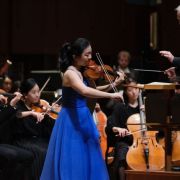
For her final-round appearance with Leonard Slatkin and the Indianapolis Symphony Orchestra, Chiu selected the ever-popular Tchaikovsky Violin Concerto. “I wanted to bring something to the competition that I felt 100% comfortable with,” she says. “I had a lot of experience with the Tchaikovsky concerto. But I feel that it also suits me and suits my personality. I’ve always loved its yearning, that is something that aligns with my personal voice.”
On the night of the finale, Chiu had to fight the overwhelming sensation of performing on a stage where she’d once been a spectator. “It was really hard to keep my [personal experience] at bay,” she says. “If I thought about that too much, then I would have been too overwhelmed to execute what I needed to do. I was really trying to stick to my process and think about the music, just the music. When I finished the first section of the piece and the orchestral tutti came over, I had a second to let my guard down and soak it all in. I just remembered my 15-year-old self sitting in the hall. I had chills, and I couldn’t believe where I was standing. It felt so full circle.”
Waiting for the results, the worldwide livestream audience got to experience Chiu in an especially unguarded moment. “The moment I was done with the Tchaikovsky, I didn’t know the camera was watching me,” she recalled. “I exited the stage right after I finished, and I just started jumping up and down! I was just so happy and it was just such a release. The timeline from that moment to the announcement went very, very quickly for me.”

Chiu’s parents were in the audience when her win was announced. It was an especially poignant moment, as her father had suffered a spinal injury shortly before she had to travel to Indianapolis for the beginning of the competition. “He had planned to take the first week off of work to come watch my first round, and he could no longer do that,” she says. “Throughout the competition, I was checking in on him and making sure he was okay. He was really sad not to be there, because this competition and this city hold so much meaning for us. He managed to come to the finals, and it meant more than I could say to have him in the audience.”
As laureate, Chiu will receive a myriad of opportunities over the next four years, including a Carnegie Hall recital and a recording contract. Speaking two weeks after her win, she felt ready to usher in the next phase of her career.
“I’ve always loved performing, but I think only now in my later 20s I’ve really pinpointed why,” she says. “I think it’s because I love connecting with people. That’s what I’m most looking forward to: connecting with people through performances, through music, through travelling the world. I’m so excited for the amount of growth and discovery I can have over these next four years.”
This article was sponsored by the International Violin Competition of Indianapolis.