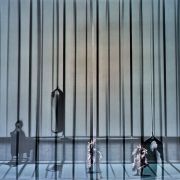
“Do you know how it will turn out?” Given the challenges of our time, many people today are asking themselves the question posed by the Norns in Götterdämmerung. The desire for security and predictability is growing ever stronger in the face of war, unrest and the seemingly ever-accelerating pace of technological advancement. We are increasingly aware that AI is not only transforming the job market, but also influencing the very way we think and act. A glimpse into the future does not bode well…

This production of The Ring to mark the 150th anniversary of Bayreuth was intended to provide a retrospective look at the entire history of its reception and to serve as a form of self-reflection for the festival. The ambition to present digital media art or an experiment rather than a traditional staging quickly gave way to a desire for authenticity, sparking plenty of debate about the relationship between art and AI.
In any case, Marcus Lobbe’s directing team has chosen the path of least resistance. Instead of genuine artistic ideas – which do not fall from the sky but are the result of hard work – this non-production is, above all, lacking in courage! Instead of aspiring to capture the spirit of the times and translate current social problems and challenges into a directorial language – just as Chéreau or Kupfer did – this represents one of the greatest missed opportunities of this Ring cycle. In Bayreuth, many directors ruffle feathers with their work. Not everything goes down well, but at least these productions are genuine works of art and not off-the-shelf products consisting of ones and zeros.

But perhaps that is precisely what the directing team is highlighting – albeit unwittingly. The corruption of the characters observed in Der Ring des Nibelungen and their associated downfall could serve as a case study for how we deal with AI. The spread of disinformation, the bias of the models (which are just as racist and sexist as their programmers) and the disastrous consequences – not only for the environment and our coexistence – show that what the models produce in the digital realm has long since become a reality.
Musically, however, the Bayreuth Festival Orchestra, conducted by Christian Thielemann, once again delivered its customary warm, authentic and virtuosic interpretation. Thielemann had the curtains drawn during the interludes, allowing the audience to lose themselves entirely in the music. Hardly anyone else seems to be as familiar with the unique acoustics of the Festspielhaus as Thielemann is. Under his baton, Wagner’s music permeated every corner of the auditorium – a sound that possessed something truly special.

Klaus Florian Vogt continued to demonstrate tremendous stamina in the role of Siegfried. Singing all the major tenor roles in the tetralogy is a rarity and demands the utmost even from experienced singers. And Vogt certainly gave his all. His Siegfried was characterised less by brute force than by a remarkable tenor elegance. Vogt portrayed the hero with a controlled, almost effortless clarity that lent the character a nobility all of his own. His stamina was particularly impressive given the role’s enormous vocal demands.
Camilla Nylund reached her limits as the Götterdämmerung Brünnhilde. While her voice is beautiful and lyrical, it occasionally lacked the dramatic impact required for the role, meaning she sometimes had to be sparing with her vocal reserves; nevertheless, she delivered a well-rounded and consistently melodious portrayal.

Mika Kares was the ideal choice for the role of Hagen. His dark, almost gruff bass reached the deepest registers with ease, lending the character a menacing presence and the necessary malice.
Magdalena Hinterdobler sang Gutrune with a fresh, clear soprano voice that lent the character youthful immediacy, while Michael Kupfer-Radecky (Gunther) portrayed a virile, powerful ruler who, despite the minimalist staging, also brought out a remarkable vulnerability in the character.

This staging has certainly given us food for thought, albeit perhaps not in the way the production team had intended. It raises many questions – questions about the authenticity of theatre, about what art is and about what the audience expects from an operatic performance. This Ring, a potpourri of AI slop, may well have failed to win the favour of the audience and the critics in its intention, but it has unwittingly become a symbol of our times and thus strikes a chord. AI is growing inexorably. It provokes. It tests the limits of the law. And no one can say where all this is leading. In this respect, our outlook for the future is only marginally better than it was at the end of Wagner’s Ring itself. The question that we must ask ourselves remains: where should we, as a society, be heading? “Do you know how it will turn out?”
Translated from German by Mark Pullinger