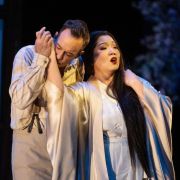
Madama Butterfly did not spring fully formed into the world as the repertory staple we know today. Bachtrack’s 2024 statistics ranked it the third most performed opera, yet Puccini’s convoluted revision history means that even this most familiar of works survives in markedly different forms. Musical and dramatic details, character relationships and even aspects of Cio-Cio-San herself changed across those revisions, until the 1907 Paris version emerged as the standard.

At Santa Fe Opera, Butterfly bookends the 2026 season: it opened the summer and will close it, returning throughout the eight-week festival alongside four other productions. Audiences are encountering a version in which Cio-Cio-San’s mother is individually introduced and her drunken Uncle Yakusidé has a comic cameo; the love duet is interrupted by Butterfly’s admission that she initially had doubts about marrying an American; and Kate Pinkerton speaks much more extensively for herself in the final scenes.
John Fiore, who is conducting the entire run, has spent years working with this version of Butterfly. An American long based in Europe and at home across a broad operatic repertory, he first developed his preferred performing edition for an Oslo production, drawing on material from several stages of Puccini’s revisions, and subsequently brought it to Santa Fe for his first Butterfly with the company in 2018. Its backbone is Puccini’s first major overhaul a few months after the failed 1904 première – the so-called Brescia revision – supplemented by material from other stages in the opera’s evolution and a few cuts of Fiore’s own.

Created for the company in 2010 by the late director Lee Blakeley and revived here by Melanie Bacaling, Butterfly revolves around Jean-Marc Puissant’s spare wooden framework for the Japanese dwelling where Butterfly hopes to build a home with Pinkerton. A large illuminated disc evokes the sun in Act 1, while the open rear of the theatre frames New Mexico’s Jemez Mountains beyond the set. As the real sun sets behind them, nature becomes part of the staging – the only one of the five productions I saw this summer to use the theatre’s open-air setting so directly.
After the interval, telephone poles and wires appear stage left. Butterfly has spent three years waiting; outside her house, the world has moved on, with modernity visibly encroaching on the landscape. Smoke from a distant wildfire also began drifting in on the evening I attended, adding an ominous reminder of the world immediately beyond the theatre.

Karen Chia-Ling Ho’s Cio-Cio-San was one of the season’s memorable performances, combining vocal presence and dramatic truth. Her soprano could soar through the orchestra with tremendous force but also floated beautifully controlled soft notes. She covered an equally broad dramatic gamut: complete sincerity in Butterfly’s faith in Pinkerton; flashes of scorn and knowing pride in her confrontations with Goro (sung with unctuous relish by Ya-Chung Huang) and the hapless Prince Yamadori (Yeongtaek Yang, who brought out his comic obtuseness); and moving protectiveness towards her child Trouble (the angelic Hanako Ingliss).
B.F. Pinkerton hardly needs further help securing his place as one of opera’s most repellent embodiments of colonial entitlement; the restored opening scene quips expose still more of his casual racism. Pinkerton’s entitlement hardly feels safely confined to Puccini’s era.

Stephen Costello didn’t shy away from making Pinkerton’s attitude towards Butterfly brutally clear from the start, which made the beauty of his singing all the more disconcerting: ringing high notes in the love duet and an almost painfully beautiful “Addio, fiorito asil”, sounding like a private attempt to purge his guilt after the damage was done. The final image sharpened that reading when his son, seeing him for the first time, fled his embrace.
Sun-Ly Pierce made an unusually strong Suzuki, capturing the clash between her helplessness and her desperate wish to spare Butterfly further pain. Her struggle to conceal her grief as Butterfly clung to the delusion of Pinkerton’s return was one of the performance’s most affecting moments. Jarrett Ott’s compassionate Sharpless seemed barely able to contain his disgust at Pinkerton’s selfishness and at the image of America his countryman projected. As Kate Pinkerton, Alissa Goretsky had a more active presence in this version, speaking directly to Butterfly in dialogue largely given to Sharpless in the standard version; Goretsky kept her cool and somewhat aloof.

Fiore made a persuasive case for his alternative edition, which gives us a more fully characterised Cio-Cio-San and restores dimensions of the surrounding characters that were pared away in the standard version. The Santa Fe Opera Orchestra sounded superb under him: Fiore’s extensive Wagner experience could be felt in the heft and textures of the orchestral sound, while the extended passage following Butterfly’s vigil unfolded with genuinely symphonic breadth. With the singers, he encouraged freedom of phrasing while remaining acutely responsive to the quick give-and-take of the dialogue and the changing drama.