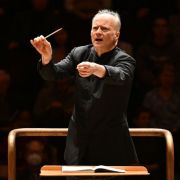
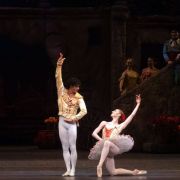
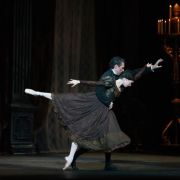
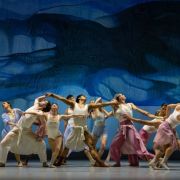
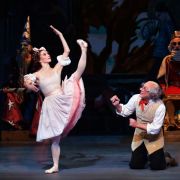
Philadelphia Ballet's new Romeo and Juliet by resident choreographer Juliano Nunes is a clear triumph. With provocative designs by Youssef Hotait, atmospheric lighting by Brad Fields and Beatrice Jona Affron’s masterful conducting, Nunes breathed new life into this classic tale of forbidden love, while remaining faithful to the Shakespearean narrative and the robust Prokofiev score. The production transcends the traditional dramedy and resonates as something surreal, whimsical and profoundly human.

A towering book labeled ‘Verona’ serves as the primary set; its pages turn to transport the audience from a marketplace to Juliet’s bedchamber, the ballroom, the balcony, the chapel, and the Capulet crypt.
As the book opens to a soft pink and blue daybreak, the ensemble enters in Hotait’s sophisticated, Elizabethan-inspired costumes — notably asymmetrical tutus and blue waistcoats with dramatic shoulders. The sword fight between Tybalt, powerfully danced by Arian Molina Saca, and Benvolio, a dashing Jorge Garcia Alonso, soared as the rich, pounding score propelled the ensemble into a vigorous dance marked by rhythmic claps and thigh-slaps.


What is most remarkable is how the simple, uncluttered set defers all attention to the narrative and Nunes’ movement language, a bricolage of neoclassical forms with modern and folk elements seamlessly woven to support the flow of diverse motion. Arabesque turns on pointe dissolve into soft hops and hip-thrusts. A buoyant undercurrent sustains the choreography, at once grand yet braided with simple skips and step-touches crowned by intricate gestures of the arms.
A large painting of a heart – blood-red and thorn-crowned – looms as the backdrop for the Capulet ball. Among the guests in deep crimson, the Montague men infiltrate the party. Their flirtation is a defiant yet graceful dance of puffed chests and twisted limbs, sharply tilted heads, undulating backs and stylized posturing.
For the infamous, foreboding Dance of the Knights, the Capulet guests in their striking crimson jackets initially mirror the score’s intensity with sharp, mechanical precision. This rigidity segues into a buoyant, gender-neutral vocabulary of arched arms, flat palms, and swaying hips; arms are swept swiftly to the back of the waist. The juxtaposition of this kinetic buoyancy against the musical severity creates the sensation of rolling upon a tempestuous sea – a metaphorical sea of crimson blood.

During the balcony scene, the book rotates to reveal a black obsidian wall with a barely hidden staircase behind it. The stage is plunged into darkness, illuminated only by a singular spotlight and a black scrim pierced with delicate apertures that shimmer like a canopy of distant stars.
In the titular roles, Thays Golz and Zecheng Liang were sensational partners, navigating the choreography with a magnetic push and pull. In a display of daring, almost reckless abandon, Liang swept Golz across his hips in a fluid arc before hoisting her overhead as if she were weightless. He swung her down and hovered her just above the ground, their momentum halted to a prayerful stillness as they paused with palms pressed together.

A highlight of Act 2 is Mercutio’s protracted death, danced on opening night by a cheeky Isaac Hollis with equal parts comic genius and virtuosic drama. Ever the diva, he refuses to depart quietly – his theatrical exit drawing laughter from the audience. Romeo, seeking retribution, slays Tybalt – an excellent, hot-headed Molina Soca – who makes a strong foil to Liang's desperate Romeo. As the page turns, we find the young couple awaking. They share their most impassioned pas de deux yet; Juliet throws herself into his embrace, her entire body wrapped around his as he swings her gently toward his chest, cradling her with a tender, childlike reverence. Golz’s Juliet was a more mature Juliet than we often see, exercising restraint and avoiding girlish naivety.

Romeo retreats just as Juliet’s parents and Paris, an endearing Jack Thomas, arrive. In a final burst of defiance, Juliet strikes her suitor – an act that shatters her parents’ previous composure and forces them to leave. As Juliet’s parents, Siobhan Howley and Charles Askegard remained mild-mannered throughout, stern in their convictions but never forceful or violent. Only her faithful nurse, a gentle and sensitive Laura Bowman, returns to swaddle Juliet in a soft, sweeping blanket before Juliet rushes off to find Romeo. As she runs, the fabric unfurls into a billowing silhouette, appearing less like a shroud and more like a flag of emancipation.

In the final crypt scene, as Paris, Thomas was regal and pure-hearted, his white costume marking him as the tragedy's most innocent figure. His grief was palpable, shoulders slumped and movements heavy, until Romeo’s arrival sparked a desperate, fatal scuffle. Left alone with the "dead" Juliet, Liang’s Romeo spiraled from bewilderment into angry despair before finally plunging a dagger into his own chest. It was an emotionally believable scene and well paced.
When Juliet awakens, Golz moved convincingly through a series of emotions, from shock, to horror, to madness. She dances a haunting duet with Romeo’s invisible ghost – a final, ethereal moment of union – before surrendering to the same tragic end.
Precision met passion in this world premiere, where electric performances and a distinctive movement style catapulted the story forward with unstoppable force.