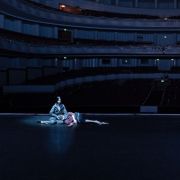
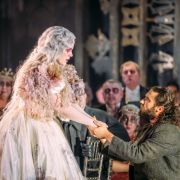
“Vissi d’arte.” I have lived for art. Annilese Miskimmon has built her entire staging of Puccini’s Tosca for English National Opera around this one phrase. Set in a concert hall, where the diva Floria Tosca performs, a police state represses the arts, confiscating instruments, smashing up a piano, piling scores onto a bonfire. A religious mural is painted over. Artistic freedom is snuffed out. With dwindling state backing for the arts – something ENO can relate to more than most – it’s a theme that feels pertinent, yet it’s clumsily delivered.

ENO describes Miskimmon’s staging as a “reimagining” – this year’s PR buzzword – but it’s nothing of the sort. At least they don’t stick the word “bold” before it. If you want reimagining, set the opera in a dystopian wasteland under six feet of snow (Martin Kušej). Instead, Miskimmon writes that her production “places Tosca at the centre of her own story.” Isn’t this exactly what Puccini and his librettists Luigi Illica and Giuseppe Giacosa already do very successfully? The creative team here just takes Tosca and plonks it in a concert hall, with all the inherent problems that creates.


Questions are raised from the start. Religion is so important in Act 1, but what place do a shrine and a mural of the Madonna have in a secular performing space? Why does Scarpia conduct his business from there? Why, if it’s set in an unspecified Eastern European state, is French soprano Axelle Fanyo singing Tosca with an American drawl? And why does she complain that the Madonna’s eyes are blue when they’re clearly not?

Rosanna Vize’s two-tier set – more village hall than concert hall – is problematic. Despite there being a ladder connecting the two levels, characters have to leave the stage to reappear in the upper gallery. The only character to use the ladder is Christopher Purves’ Scarpia, who climbs up there for a little rest during “Vissi d’arte”. There’s an awful lot of stage traffic during moments supposedly shared between just two characters – Chaz'men Williams-Ali’s Cavaradossi appears to have subcontracted his mural to a team of painters – although I like that Angelotti (study bass-baritone Alaric Green) is smuggled out of the hall in a props box.
State violence is brutally portrayed. During the Te Deum, the off-stage cannons fired to celebrate victory over Napoleon now become bombs exploding (exactly as in Oliver Mears’ recent Royal Opera staging). The chorusmaster conducts at gunpoint, while Attavanti is dragged up to the gallery, screaming, and is knocked to the ground as Scarpia’s henchmen begin to wreck the joint. In Act 2, Robert Hayward’s sturdy Sacristan – here the hall’s caretaker – lies dead. Scarpia smashes a violin in a fit of anger.

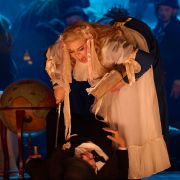
There are moments of unintended comedy. After Tosca has slashed Scarpia’s throat with a palette knife – confiscated from Cavaradossi before his torture and carelessly discarded by Spoletta – she sits on him and smothers his face. “He’s dead now!” she exclaims and someone in the Stalls giggles. Finding the doors locked, Tosca has to find a way to hide the evidence. Spying a double bass case, she drags it towards Scarpia’s lifeless body. Someone else corpses.


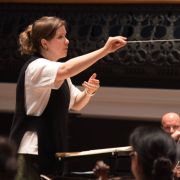
Musical compensations are few but rewarding, led by Ben Glassberg’s terrific conducting, drawing a ripe sound from ENO’s excellent orchestra and sensitive to the needs of his cast. As one of the choristers, the Shepherd Boy – either Elliot Michael or Tristan Meziere (the role is shared and the programme is vague) – was sung beautifully. ENO’s Chorus sang lustily, although having the Act 2 off-stage cantata performed very much on-stage created massive balance problems in terms of hearing the confrontation between Scarpia and Cavaradossi going on downstairs.

Fanyo tackled the title role passionately. Her soprano has some really rich lower notes and she rode the large orchestra with ease. Her “Vissi d’arte” was sincerely phrased, despite a tight climactic note. A few weird vowels aside, her diction was clear, occasionally hampered by Amanda Holden’s arch translation (“protracted” to rhyme with “a scene I have acted”). Purves’ oleaginous Scarpia sounded hollow, but he got by largely on stage charisma and a dry Sprechgesang. Williams-Ali’s throaty Cavaradossi was less than distinguished.
The press were requested not to give away the “theatrical staging” of the ending. Spoiler alert: Tosca still kills herself, just not by leaping off battlements that aren’t there. A theatrical staging of the denouement would be the Marchesa Attavanti turning up and putting a bullet through Tosca's brains (Kušej again). This staging is nothing radical. It’s just the operatic equivalent of a village hall pantomime.