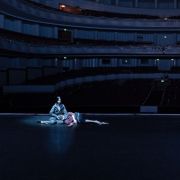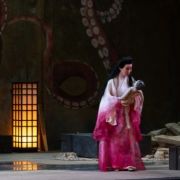


A music box tinkles a theme from the Dance of the Seven Veils. Dressed in a black velvet dress with a white lace collar, a young Salome plays with a doll. She begins ripping off its limbs before smashing it to smithereens. A clarinet slithers into action and Richard Strauss’ opera begins. Welcome to the wonderful world of Claus Guth.

It may be stating the bleeding obvious, but opera is meant to be experienced live. As much as I enjoyed watching the Met in HD’s cinema screening of Guth’s Salome last year, nothing beats the thrill of seeing it in the flesh. On film, one is beholden to the video director’s choice of camera shots; live, you see the wider picture. It’s a bit of a coup for Polish National Opera to secure Guth’s staging, which now premieres at Teatr Wielki. Officially it is a co-production with Madrid’s Teatro Real, but is essentially the same as seen at the Met, previously at the Bolshoi.
The only significant difference is that at the Met, Étienne Pluss’ stage rose spectacularly to reveal the underground cistern in which Jochanaan is incarcerated. Here, it wheels in from the side – not quite far enough to the centre, meaning the audience on the extreme left of the house may have a few sightline issues.


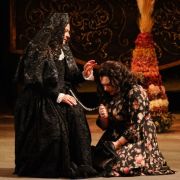
The production is set around the time that the opera’s source material, Oscar Wilde’s scandalous play, was written. Pluss’ set is a dark Victorian mansion with secret wood panels through which white-gloved hands appear to top up Herodias’ Champagne glass, light her cigarette or to fondle her.
Herodias is dressed in scarlet – like a splash of blood among Ursula Kudrna’s monochromatic costumes. An animalistic masked S&M orgy is taking place towards the rear. Herodes makes his initial appearance wearing a ram’s head, in pursuit of his stepdaughter, Salome.

Guth presents a story of sexual abuse. Salome has been serially abused by Herodes since childhood, exposed in the Seven Veils, where a succession of younger Salomes appear, wearing black veils, which Salome removes. Herodes, wearing his ram’s head, is forced to witness his crimes portrayed, like Claudius watching the play devised by Hamlet, as the mini-Salomes are coaxed, coerced, punished or rewarded. “It may be that I have loved you too much,” opines Herodes, a line here given a sinister double-meaning.

Salome has been conditioned to think she can use sex to get what she wants. When she demands to see Jochanaan, she gropes Narraboth and spreads her legs. She cannot comprehend it when she fails to get what she wants from the prophet. The girl Salomes populate the cistern, which is scattered with toys – a rocking horse, a music box, a spinning top – symbolic of a childhood she has been denied. Jochanaan himself is whiter than white, caked in chalk.

In the final scene, where Jochanaan’s head is served up, on a silver charger, by one of the mini Salomes, she smears her mouth in blood from the headless body before washing the hands of her younger selves, cleansing them.
Strauss himself described Salome as “a scherzo with a fatal conclusion”. As moonlight pierces the stage fog, it is Herodes who dies here, clutching his chest, leaving Salome to walk free into the night.


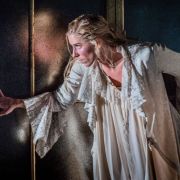
Salome is a punishing role, on stage for much of the evening and with a huge orchestra to ride. It is usually the preserve of experienced dramatic sopranos, but here, it was taken in an astonishing role debut by 28-year old Polish soprano Monika Radecka, who completed her vocal studies at the Karol Szymanowski Academy of Music in Katowice just last year. She looks the part and has the vocal resources for much of the role, with gleaming top notes. Her lower notes are, as yet, a little hollow, but she is a singer of enormous promise. Dramatically, she was outstanding.

Radecka was surrounded by a couple of world class singers in their respective roles. Polish baritone Tomasz Konieczny was a tower of vocal strength as Jochanaan, with a simply huge voice and a commanding stage presence. Gerhard Siegel was an oily Herodes, an experienced old hand in this staging, having sung it at the Met. Dramatic soprano Nadine Lehner was a vocally incisive Herodias, who seems shocked at the Seven Veils revelations, but has presumably been turning a blind eye to it for years. Tenor Granit Musliu’s Narraboth was vividly sung, impaling himself on a shard ripped from the cistern’s bannister.
The Teatr Wielki’s new Music Director Yoel Gamzou drove the orchestra pretty hard, Strauss’ lurid music oozing from a pit bursting at the seams with harps, celesta and percussion perched precariously at the side of the stage. If the strings occasionally lacked silkiness, the orchestra relished the grislier climaxes quite gloriously.
Mark’s press trip to Warsaw was funded by Polish National Opera