There’s something charming about the thought that a story set in a nameless Moravian village is significant enough, human enough, to be performed in an opera house large enough to seat all of its villagers and their cows dozens of times over. Music, Janáček’s Jenůfa providing a fine example, can masterfully explore the scale of human emotion, interpersonal dramas, the tragedies of everyday people. But music is also a physical thing that exists and moves through not only time, but space – when we allow it.

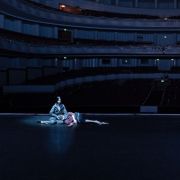
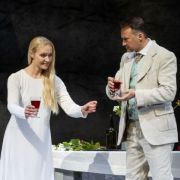
On Monday, New York was finally treated to Claus Guth’s staging of this grim Czech masterpiece, with Asmik Grigorian in the title role. Stark and largely monochromatic, Guth creates a visual language of severity through everyday objects. Because of its scarcity, color comments loudly anywhere it’s present: a baby’s knit cap, yellow poppies on the ground, festive wedding guest attire. Gesine Völlm’s costumes are wonderful, especially the ethnic dress of performers at the wedding. It’s a shame they are visible so briefly, but that may well be the point. As something to look at, it’s a fascinating piece of art. As a staging that people must act through and sing through, there are issues.


The strongest impression left by the performance was one of suffering singers. Even just a meter or two upstage, voices known for being quite commanding were dulled. While it is easy to want to blame Grigorian and Nina Stemme, singing Kostelnička, for perhaps not projecting at full force, it became clear that getting their voices across the pit would come at a cost. Grigorian was often up on a chair, as if the extra height might finally help her voice escape a stage quite literally covered with mattresses. They seemed to reserve themselves for moments of the score that are meant to be particularly dramatic, but because the rest of the story was muddled by the acoustic situation around them, the tension did not form and hold over the arc of the story as it should have. Both put more power into the final act, which resulted in the impression of an unearned resolution on top of a couple hours of tentative, messy mumbling. Tenor Ryan Capozzo was likewise challenged on stage, his Števa well acted, but barely audible. Even the choral music suffered from vocal blur.

For his part, tenor Sean Panikkar in his role debut as Laca – a part he assumed only six weeks prior to the premiere – was the vocal star of the evening. Panikkar offered strong projection, perhaps aided by his ability to stay farther downstage, but also presented a remarkably nuanced complexity in both voice and acting. His Laca was a little evil, a little pitiful, and almost a little too beautiful, caught between the depth of his emotions and the relative lack of authority he held in this small world. Exercising a great level of vocal command, his Laca started off jumpy and brash, maturing into a steadier, more pensive, richly colored voice. Among the minor roles, Erica Petrocelli delivered a loud and vibrant Karolka in the final act.


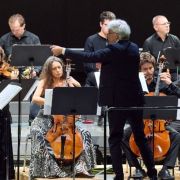
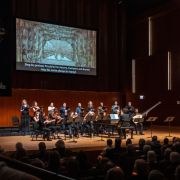
Conductor Tomáš Hanus, in his own Met debut, kept the pit tidy. The orchestral music was so excellent, it almost made the matter of what was happening on stage register as background noise. The violin solo in Act 2 was especially poignant, further reinforcing the disconnect from the vocal performance. Returning from the first intermission, Hanus did seem to turn the volume down on the entire orchestra – an act of mercy for the singers although it did not help the larger situation all that much.

While Guth’s concept might be a worthwhile contribution, as it stands it is not a fit for the Met in the most tangible sense. Janáček’s sensitive treatment of the music of the Czech language deserves to be heard in partnership with the excellent orchestral work. Compromising the vocal performance nonetheless underlines one possible aspect of Jenůfa’s story: simply having a voice does not mean that you won’t have to fight, brutally, to be heard by those closest to you, and all the more intensely to be heard by the world.