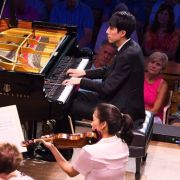
Massachusetts native Eric Lu made his Tanglewood debut yesterday, backed by his hometown Boston Symphony Orchestra. The performance capped a whirlwind season for the 28-year-old pianist, who won the International Chopin Piano Competition last October, becoming the first American laureate since Garrick Ohlsson in 1970. Having previously triumphed at Leeds in 2018, he joined the company of the late Radu Lupu as the only artists to have taken two of the four major international piano prizes.

It only made sense that Lu would perform the work that clinched the Gold Medal for him: Chopin’s Piano Concerto no. 2 in F minor. Perhaps due to his familiarity with the work, he exuded a sense of poise throughout the difficult piece, as relaxed in the elegantly shaped phrases of the Maestoso as he was with the buoyant mazurkas of the Allegro.
If this equanimity garnered respect for his technique, though, it also underlined a polished blandness in his playing. Always clean and shapely, Lu missed the unsettled angst of the first movement – something conductor Fabio Luisi never let the audience forget in his driven accompaniment. The second movement’s Nocturne, thought to represent lower-case romantic obsession, never reached an upper-case Romantic boil. And while the finale was technically perfect, the rough-and-ready energy of the strings captured as much of my attention as the piano, if not more. Lu’s graceful approach to pianism served him better in his encore, Schumann’s Träumerei, which he rendered with an appropriate sense of repose.

Contrasts define Brahms’ Symphony no. 2 in D major. Although the composer set each of the four movements in a major key, needling minor-key dissonance persists, casting a pallor on what some have described as a joyful tribute to nature. An optimal performance should balance the outward jollity with the roiling subtext – particularly in the first two movements, which demonstrate more turmoil than the ebullient conclusion. Unlike the Chopin, full of mood shifts from the orchestra’s end of things, Luisi kept a fairly even pulse here, resulting in a reading notable for its refinement, polish and lack of perspective. Phrases often emerged in long breaths where terse utterances would have been more distinctive.
Strings carried weight in the Allegro non troppo and the cellos brought a rich, imposing quality to their theme in the Adagio. There were fine individual contributions from Richard Sebring (horn), John Ferrillo (oboe) and Lorna McGhee (flute). But it wasn’t until the assertive abandon of the finale, with its fabulous trombone fanfares played to the hilt, that the symphony truly caught fire.

The concert began with a lovely miniature: What do flowers do at night?, by the German composer Sophia Jani, who was in attendance. Jani wrote the piece after learning about a cactus species called Selenicereus grandiflorus, which blooms each year for only one night, before shedding its blossoms for a long hibernation. She mirrored this phenomenon in the orchestra: arpeggiated phrases passed from one section to another before reaching a lush, collective swelling, which gradually faded to a blissful quietude. Luisi handled the work’s slow burn skilfully, culling gorgeous tone especially from the petal-like notes heard from the woodwinds. The performance built to a climax that was melodic and ecstatic without turning excessive.