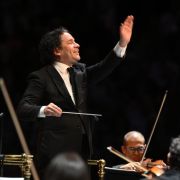
At the weekend, Thomas Adès conducted the National Youth Orchestra of Great Britain at the BBC Proms in Purgatorio – the second act of his Dante ballet score. This evening, Adès was back at the Royal Albert Hall for the first act – Inferno – but this time from the safety of the stalls, handing the baton over to Gustavo Dudamel, who conducted the world premiere with the Los Angeles Philharmonic back in 2019, long before the ballet itself hit the stage in Wayne McGregor’s choreography.

Incredibly, the LA Phil hasn’t appeared at the Proms since 2002, so this was a welcome return, even if the performances themselves were very mixed. Dudamel has a strong sense of rhythm and is at his charismatic best in music of the 20th and 21st centuries. He made a thrilling case for Inferno.
In this opening act, Dante and Virgil journey through the gates of hell (Abandon Hope), transported by the Ferryman into the underworld where they descend through the Circles of Hell, encountering various sinners and ne'er-do-wells on the way to the frozen depths, where Lucifer is trapped in ice. Despite the sombre subject matter, Inferno is frequently a riot, not least because listeners can play a game of ‘Spot the Liszt Quotation’, sometimes a fleeting reference, at others Liszt filtered through Adès, a sort of witty conversation between the two composers.
The Ferryman lurches along to La lugubre gondola; in The Suicides the foreboding Dies irae motif channels Liszt’s Totentanz and there’s a sulphurous whiff of the second Valse oubliée in the skittering Deviants. Most riotous of all is Thieves (devoured by reptiles) which is an orchestration of the Grand galop chromatique that Adès turns into a demonic cancan. It always brings the house down – as it did in this exuberant rendition, Dudamel having to signal to the whooping audience that, no, that wasn’t the end of the work. The hawk-eyed Adès chuckled.
The LA Phil threw themselves into this wild ride, especially the kitchen sink percussion department, from thunderous timpani to whip, ratchet and sleigh bells. Tuba and trombones belched sulphur. It’s not all crash, bang, wallop – the strings in the courtly Pavan of the Souls in Limbo were graceful, with queasy portamentos in Paolo and Francesca; a plaintive cor anglais in The Ferryman reminiscent of Sibelius’ Swan of Tuonela. Dudamel and the Philharmonic completely sold this music – a virtuoso score played by a virtuosic orchestra.
To be considered a great conductor, do you need to perform the central European classics? Dudamel seems to think so but has rarely had anything genuinely interesting to say about the repertoire. Nothing about this Beethoven Pastoral Symphony at the BBC Proms changed that opinion.
Big band Beethoven is all well and good – the Los Angeles Philharmonic fielded as many strings as in the Adès – but this journey into the countryside resolutely refused to get its boots muddy. It was more a case of pulling the hood back on a flashy sports car, settling into the leather upholstery and taking a drive along the Hollywood Freeway. The first movement was a breezy speed-read, the Scherzo turbo-charged and sleek, lacking any peasant rusticity. With some poised woodwind solos, Dudamel took time to stop and smell the flowers in the Scene by the Brook but, despite expending much energy on the podium, the Storm was tame. The principal horn had a Shepherd’s Song to forget, but then this was an entirely unmemorable Pastoral.