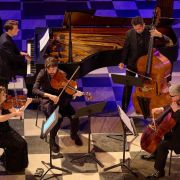
Five days of artists rehearsing, collaborating and performing together; of forming new ensembles and creating bespoke concerts that are intimate, inspiring and unrepeatable… If the format of pianist Alessio Bax’s inaugural London Festival of Chamber Music sounds familiar, it’s because it’s doing a neat thing: borrowing back for a major city the most special aspect of rural summer music festivals, i.e. world-class artists presented within an entirely more up-close, intimate and one-off context than is the case for the major city concert series they’re usually to be heard touring.

Indeed, Bax’s festival delivers especially profoundly on the intimate aspect by dint of its seating configuration in Smith Square Hall having no audience member more than a few metres away from the musical action: the seating is curved in a wide semicircle around a floor-level performance area situated midway along the hall’s long horizontal side, rather than shorter, straight rows filing back along its length from a stage. Hence why, midway through the convivial flow, pounce, snap and song of Thursday night’s Schubert “Trout” Quintet from Bax, violinist Natalia Lomeiko, violist Lawrence Power, double bassist Nabil Shehata and cellist Paul Watkins – the second half of a programme entitled “Voyagers” – there came a moment when it suddenly dawned upon me that, with this proximity to such a unique line-up of chamber ninjas, all themselves radiating pleasure and energy in the occasion’s intimacy and ‘one-time-only’ nature, it was all feeling more like a night at Bax’s Tuscan summer music festival, Incontri in terra di Siena, than it was a weekday night in London with a chill wind blowing outside. Every tiny facial or musical gesture, every technical and relational element, was gloriously immediate. Sneeze hard, and you might have hit them.
The voyage of the concert’s first-half vocal recital, from French Cypriot soprano Sarah Aristidou, drew on an entirely different treasure chest of folk influences: those of the eastern Mediterranean. This had some truly mesmerising moments as Aristidou, with Ravel as her programme’s linking thread, turned her often astonishingly agile, light voice one moment to impassioned folk style coloured by eastern trilling and microtonal inflections, and the next to softer coloratura sweetness. Her curtain-raising unaccompanied traditional Cypriot song, Agía Marína, gently echoing around the church acoustic, set the high-impact bar on a top notch where it then remained. Ravel’s Chanson des cueilleuses and Maurice Delage’s Quatre poèmes hindous were as memorable for Lucille Chung’s soft, bell-like eloquence at the piano as for Aristidou’s fluid vocals.

If there was a highlight of her set, then it was perhaps her partnership with Shehata, him performing French-Syrian François Rabbath’s double bass solo, Ibérique Péninsulaire, as she improvised an eastern-influenced vocalise around it. If there was a triumph, then it was perhaps Ravel’s Shéhérazade, accompanied by Bax – a tautly spellbinding, sultry evocation of ancient Eastern romance and shimmering exotic heat that didn’t waver for a second as an audience member was taken ill. What with that and a couple of significant mobile phone disturbances, Aristidou was beset with an unusually high element of disruption, but you’d simply never have known it. This was as much a masterclass in serene composure as it was in the creation of hypnotic musical universes.
If the evening had one slight disappointment, it was to see that not every seat was filled. Still, for the reasonable-sized audience who had come, this meant the satisfaction of being party to what felt like musical London’s newest best-kept secret. Certainly, once word spreads, this festival will be having to turn people away at the door.