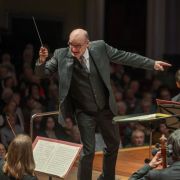
Andrew Manze conducting the Scottish Chamber Orchestra in Beethoven: what’s not to like? One of my most vivid concert memories is of Manze conducting the Eroica with the SCO back in 2012, and in the intervening 14 years they have lost neither their energy nor their edge. Strings that played with lithe transparency balanced period brass (and timpani) that both brayed and bounced their way through Beethoven’s score as though the music had only just been written, while Manze both balanced the textures and directed the music’s trajectory with the skill of a musician who has held this music dear for decades.

In the first movement, for example, he almost danced his way through the development, so much vigour did he bring to its biting cross-rhythms, while the moments of major-key brightness in the funeral march seemed to hold out majestic hope that was all the more intense for being so cruelly snatched away. The Scherzo rollicked, geed on by its choir of natural horns, and the finale moved towards a coda that glowed with the satisfaction of a journey fulfilled. In short, brilliant.
The orchestra brought just as much agility to Haydn’s Cello Concerto no. 1 in C major... and they needed lots of it to keep up with Sheku Kanneh-Mason on the solo line! Kanneh-Mason has just come back from an enforced absence due to injury, but you’d never guess that from the liveliness of his playing in Haydn’s outer movements. In the first movement every run was invested with significance, while his bow positively scampered over the quicksilver finale. Throughout, he brought an oaky intensity to his playing that included a terrifically rich middle register and slow-breathed meditation to the long lines of the second movement. Even his cadenzas managed to sound thoughtful and, at times, almost poetic, and the orchestra matched him with bright strings and, in the slow movement, a lovely cushion of support.

For once, however, Kanneh-Mason wasn’t the most interesting young musician on the stage. If it seemed like it was a different orchestra playing Jay Capperauld’s new piece, that’s because it was. Not only were the SCO using modern instruments for Capperauld’s Sinfonietta, “Pathways”, but they were joined by around 40 young musicians from the SCO Academy, a scheme that gives string players in the 11-18 age bracket the chance to rehearse and perform alongside the professionals of the SCO. They even collaborated with Capperauld in some of the composition, and Pathways’ meditation on different types of journey lent itself to creating a frame in which young musicians could both experiment and feel supported. Frequent repeated chugging patterns gave the strings an anchor for the structure, but alongside this Capperauld wrote some sweeping, almost cinematic themes and used some magical special effects like eerie string glissandi that sounded somewhere between ghostly and spiritual. Sometimes the repetitions felt a little over-extended, as though they were hanging around after they had made their point, and the final movement, in particular, felt like it was chasing its own tail for too long. Still, it’s to Capperauld’s credit that he collaborated with these musicians in the way that he did, and the music’s warm tonality showed that he can write a tune as well as any contemporary composer.