This programme of Three Short Ballets has become an annual event for Northern Ballet, describing their collaboration with The Royal Ballet since the latter’s former principal dancer, Federico Bonelli, became the artistic director of the Leeds-based company. The short season in the Linbury Theatre, underneath the Royal Opera House, enables the company to show work from its one-act repertoire that might not otherwise be commercially successful.

The Royal/Northern association gained an extra layer since the three one-act ballets were augmented by the late inclusion of three pas de deux of pieces in the ownership of either company, danced in each case by a couple comprising dancers from both companies. This additional content was announced by ballet’s newest double act as Bonelli and his former boss, Royal Ballet director, Kevin O’Hare, took to the stage to announce the duets as a tribute to Aud Jebsen. Her philanthropy reaches into many corners of the dance sector but amongst Jebsen’s largesse is support for Bonelli’s position in Leeds and a more than decade-long sponsorship of the Aud Jebsen Young Dancers Programme at the Royal Ballet. 71 dancers have benefitted from this initiative, and it was a surprise to learn from O’Hare’s presentation that more than half of the current company joined via the programme. Jebsen was present to receive a well-deserved ovation.


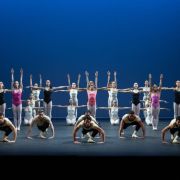
All of this meant that “three short ballets” added up to over three hours (including two intervals). It began with Tiler Peck’s Grandes Études, a new commission for Leeds which is soundly based in New York. Peck is New York City Ballet through-and-through and the fast-paced, characterful whimsy in the interplay of four couples was more than slightly reminiscent of Jerome Robbins’ Dances At a Gathering.
The women wore pastel-coloured, floaty long dresses and the men sleeveless leisure wear. It was pretty, expressive and engaging, titled for and danced to Liszt’s Grandes Études de Paganini, performed with scintillating expressiveness by the concert pianist, Rose McLachlan. Peck’s choreography was a pleasing visual interpretation of this flamboyant music, but it was for the moment and not the memory.

The three injections of unrelated pas de deux began with the duet from The Royal Ballet’s An American in Paris, danced delightfully by Anna-Rose O’Sullivan (who a year ago was performing the full-length musical theatre production by Christopher Wheeldon) partnered strongly by Harris Beattie; the ballroom pas de deux from Frederick Ashton’s Cinderella, danced with mild hesitancy by Northern Ballet’s Saeka Shirai, and the home company’s Reece Clarke; and finally the Heavenly Space duet from David Nixon’s The Great Gatsby, performed by Ryoichi Hirano as Gatsby, and Sarah Chun as Daisy. It was a dream partnership and a great pity to be just a one-off for this tribute. I recall Hirano having a guest stint with Scottish Ballet and, as he nears the end of an impressive career, a similar period with Northern Ballet would be a fascinating prospect.

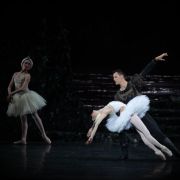
The middle work in the triptych of “short” ballets was a welcome opportunity to catch Hans van Manen’s 5 Tangos, now one year shy of its fiftieth anniversary. Van Manen’s hybrid of the smoulder of Argentine tango and the coolness of classical ballet, both highly disciplined, has become a twentieth century classic. The Northern Ballet cohort danced with precision and a necessary degree of mutual flirtation, but I didn’t get any fieriness until Cesar Corrales (guesting from The Royal Ballet) burst onto the stage for a truly scintillating solo of immense virtuosity. It was a highlight of the evening and a superb reintroduction of Corrales to the stage after a lengthy period of injury.


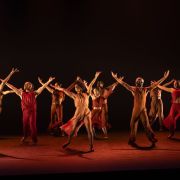
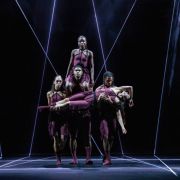
The performance closed with a revival of Mthuthuzeli November’s Fools, a narrative ballet based on the novel Hill of Fools by R. L. Peteni. It is essentially West Side Story transferred to a South African township where a young man from the Thembu people (Beattie) falls in love with a young woman from the Hlubi village (Chun).
There is an ancient feud between the two groups and tragedy unfolds after the love affair is rumbled. The expressiveness of the tragedy is sensitively handled, Beattie and Chun are perfectly aligned as the lovers, and the fight scenes are effectively conveyed, but there is perhaps too much running around with characters coming on one side of the stage just before hurtling off the other.

The simple set design by November in association with Steve Wilkins captures the realism of the township with great effect. Antoni Cañellas Artigues was also excellent as the brooding vengeful presence of the lead Hlubi male (an equivalent of the George Chakiris character in West Side Story).
This visit has become a very welcome part of London’s autumn dance calendar, and it was pleasing to see the company in good form across the excellent content of this diverse programme.