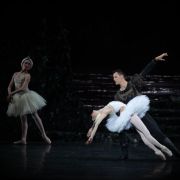
A colleague told me today that she was shocked at the realisation that her goddaughter was now 25 years old. Where have all the years gone, she asked. I had precisely the same sensation about Cassa Pancho’s Ballet Black reaching its quarter-century, recalling their fifth and tenth anniversaries as if they were much more recent! I still have the DVD given to guests at their tenth anniversary party in the tiny Clore Studios “up in the gods” of The Royal Opera House!

To Pancho’s credit, her dream of a fully-fledged ballet company, giving professional performances and training hundreds of young dancers is now well and truly established. I would wager a strong bet that she has also commissioned more new work in the last 25 years (albeit mostly small-scale) than any other UK dance company: unbelievably the new work in this double bill is the seventieth piece in the company’s history!
Some of these works – Cathy Marston’s The Suit, Christopher Hampson’s Storyville, Arthur Pita’s A Dream Within a Midsummer Night’s Dream, Mthuthuzeli November’s The Waiting Game and Ingoma and the two pieces by the late Liam Scarlett, to name but a few – will live long in the memory and deserve regular revival. Sadly, I don’t feel the same way about Hope Boykin’s quasi-autobiographical …all towards hope, which doesn’t have that special ingredient to enable it to be held in the memory for long.


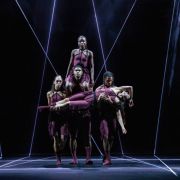
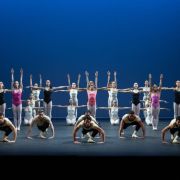
It’s not a bad or disappointing ballet. Much of the movement is pleasing, especially a dreamy solo for Isabela Coracy, and it washes over one’s senses. It’s dance for the moment and not for the memory, beginning and ending with a kind of organic tableau with the dancers arranged like a clutch of reeds waving in the wind and then posed as if in an Edwardian photograph facing in separate directions and at different levels.
The original score by Bill Laurence is book-ended and interrupted by Boykin’s own voiceover of text that she had written, all about hope in both a personal and aspirational sense. In the absence of a set, Jessica Cabassa’s costumes did the heavy lifting for design content, creating a dream-like atmosphere that fitted the hopeful thematic.
All ten members of the BB ensemble performed, and Boykin’s choreography, an interesting fusion of modern, neoclassical and classical technique, used the stage interestingly, aided by David Plater’s excellent lighting, with various permutations from the whole group to breakaway solos, duets and trios, often performed simultaneously with different movement motifs.

There seems to be a fashion in new work these days for ‘false endings’, and the audience was tricked several times into believing that a dancer exiting the stage or a change in the lighting was the end with applause to boot. The steady beat of the music was uncomfortably soporific, and the work would have been better with a few minutes’ edited away.
As readers would already have deduced, I view November’s Ingoma as one of Ballet Black’s defining works. Made in 2019, it is a work that I have seen several times across different venues and I have liked it more on each viewing.
November is now a major international choreographer, and as his first major work, Ingoma was deeply personal, drawn from both a painting and a poem, representing both poignancy and anger at the historic treatment of striking miners in his South African homeland.


The atmosphere of a mine setting was articulated through the dancers’ costumes of overalls and mining hats with lamps alight, dragging equipment and tools across the stage to create an effective image of hard labour. Ebony Thomas took on the role of the Husband, originally danced by November himself, giving a solo of challenging physicality, stamping and gesturing until exhausted. There is also a poignant, heartfelt duet with Coracy as his Wife, highlighting both their vulnerability and strength in a mutual bond that is reinforced by the many and varied ways in which the couple interact; and there is an impressive concluding female solo for Mikayla Isaacs.
Plater’s lighting was again critical to the work’s imagery, alongside Yann Seabra’s excellent costume designs. The bespoke score by November and Peter Johnson was a major element in establishing the theme. There is also spoken text in an indigenous language.
When November’s work was shown seven years ago, it was paired with Marston’s award-winning The Suit and he was very much the newbie, untried choreographer. It’s a credit to Pancho’s talent-spotting antennae that, just seven years later, he is a choreographer in huge demand internationally.