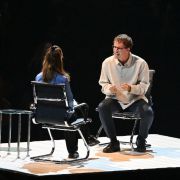


With Trouble in Tahiti, Leonard Bernstein proved himself a genius at skewering the iconography of 1950s America almost before 1950s America had really become a thing. Written on his honeymoon, if you please, Bernstein’s perfect little cocktail of marital strife in the suburbs is equal parts neat satire and piquant reflection on what it means to be man and woman in captivity. Modelled on the fraught relationship between Bernstein’s own parents, Sam and Dinah come to realise that they’ve forgotten how to communicate with one another without arguing. Sam checks all the boxes for male anxiety – sex, athletics, work, narcissism – while Dinah skips her son’s school play and instead takes a trip to see her analyst, followed by the movies, where the lurid ‘Trouble in Tahiti’ presents a troubling vision of a world that’s a great deal more exciting than what she’s enduring.

Adam Wiltshire’s slick, minimal period styling for Guildhall is the perfect complement to Ashley Dean’s carefully structured direction, everything expertly balanced on the tipping point between comedy and tragedy. Both principals will do better when they’re able to relax and remember that real people feel a range of emotions all the time – it’s the difficulty of pinning down feelings that’s at the troubled heart of this piece. But that will come in time, and meanwhile Twm Tegid’s wonderfully virile baritone gives Sam plenty of swagger and just a touch of desperation, while Cecily Shaw’s burnished mezzo gives Dinah the rich hidden lustre that – one day (come on, Dinah) – will answer Tahiti’s call. Thomas Aminfar-Antoniw, Gennady Grebenchuk and the caramel-voiced Laura LeVoir are altogether delicious as the trio of real-estate sirens luring us all to pretty little houses in suburbia.


A sign in the foyer warned: ‘Please note this production contains adult content, including scenes of slapstick, violence, threats and weaponry. There may be loud noises and haze.’ I assume this referred not to love and marriage per se, though on tonight’s showing both should be approached with caution.

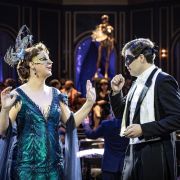
Gian Carlo Menotti’s work doesn’t often make it to the stage these days, perhaps because his music so emphatically failed to recognise that any part of the twentieth century really had happened (he includes in this opera a joke about ‘modern music’). But even so there’s a lot of fun to be had with a score that sounds like someone handed Puccini the Tom & Jerry portfolio, and so here we are with all the schmalz and runaround gusto the orchestra can muster, plus a riot of colour and texture (in contrast to the first half, Wiltshire does a gaudy, maximalist boudoir) and with Zoë Jackson in the title role, a female lead to blow the doors clean off this madcap bedroom farce.

Amelia wants one thing: to go to the ball. It is her misfortune to be married to a man who won’t take her, and to have a lover who is a bit slow when it comes to taking the hint. What’s a girl to do? Engineer an escape plan involving a window, a rope, a pistol, a vase and – eventually – the chief of police. There’s nothing minimal about Menotti’s frenetic fancy dress caper, and Dean’s direction let loose on Wiltshire’s cartoonish set is a masterpiece of comic choreography. He has the cast to support his ambitions. Jackson is an absolute knockout as Amelia, with a voice that can do everything: dominate, cajole, weedle, beguile. There’s no doubt that from the off she’s going to get her way, but that only makes the anticipation all the more pleasurable. Tegid reappeared as her officious husband, the perfect foil, until Sebastian Hill swung in as Amante, all poetic ardour and a meltingly sweet tenor voice, poor sap. A wild release of neighbours in various states of undress, answering Amelia’s cries for help, is complemented beautifully by the gentle gravitas of Yonwaba Mbo as the Chief of Police. Amelia shall – of course - go to the ball.


While the pratfalls came thick and fast on stage, conductor Dominic Wheeler kept things steady in the pit with an orchestra that sounded more relaxed with camping up the Menotti than they had with counting their way through the Bernstein, which will (just like Sam and Dinah) be better for bedding in. Both pieces make some ferocious technical demands, but these are dispatched with blistering panache.
Imaginative repertoire, fully committed performances, and yes, laughs. If only more nights at the opera were like this one.