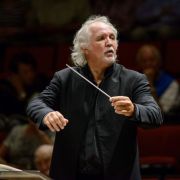
Sir Donald Runnicles joined the New Zealand Symphony Orchestra for an evening of Strauss and Brahms that found both him and the orchestra in commanding form. There was plenty of richness in Runnicles’s Strauss and Brahms, but very little heaviness. Even in the broadest passages, he found warmth and room for the music to breathe without losing forward momentum.

The opening Der Rosenkavalier Suite was quite simply delicious. Runnicles found just the right balance between the kitsch and the sublime in this collection of excerpts from the opera, maintaining easy control over its sudden changes of mood. The Prelude surged forward with a suitably sensual blend of brass and strings, voluptuous but thrillingly propulsive, before giving way to passages of almost ghostlike delicacy in some of the early waltz themes. In the Presentation of the Rose, the oboe emerged beautifully from the orchestral texture, while later, in the music drawn from the final trio, the orchestra seemed to sing so naturally that the absence of voices was scarcely felt. While the brass sometimes seemed to sacrifice some accuracy to its enthusiasm, particularly in the Prelude, they were superb in this sumptuous climax. This concluding thumping waltz was allowed to become properly delirious, increasingly extravagant while never escaping Runnicles’s grip.
Soprano Madeleine Pierard joined the orchestra for Strauss’ Four Last Songs, the work after which this concert was titled, giving an interpretation that felt lived-in. There was close attention to the text throughout, with changes of colour and emphasis growing naturally from the words. Her shimmering vibrato gave the long lines an unusual vibrancy, while the voice possessed enough weight to give substance to the low-lying opening phrases of Frühling. Only occasionally in the middle register was she briefly covered by Strauss’ dense orchestration.
Each song acquired its own flavour. In September, Pierard’s voice seemed to deepen and ripen as the song moved towards its vision of autumnal decline, nurtured by another gorgeous horn solo. Beim Schlafengehen brought one of the evening’s loveliest moments in concertmaster Vesa-Matti Leppänen’s beautiful and expansive violin solo, after which Pierard’s voice bloomed magnificently on the song’s soaring final phrases. Runnicles favoured relatively broad tempi and in Im Abendrot that spaciousness, with Pierard’s deeply felt contribution, became something approaching serenity as Strauss contemplated death.
The same balance between breadth and forward movement characterised Brahms’ Symphony no. 3 in F major. Runnicles maintained clarity of texture without skimping on Romantic weight, drawing particular attention in the first movement to the interplay of the lower strings and allowing plenty of elasticity without losing direction. The brass playing here was glorious, not least the glowing horn tone as the movement’s principal material emerged. Pizzicato details also registered clearly through the texture. The second movement remained unmistakably an Andante, flowing naturally, with mellow clarinet playing introducing a series of beautifully shaped woodwind contributions. That relatively flowing tempo might have reduced the contrast with the Poco allegretto third movement, but Runnicles instead differentiated the two through colour. Here the strings took on a darker warmth, the instantly recognisable cello theme unfolding with an almost vocal naturalness. The finale brought surging intensity without ever sounding hard-pressed. This turbulence made the gradual withdrawal of energy in the closing pages all the more affecting.