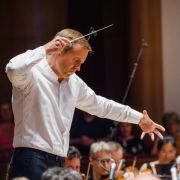
Once Vasily Petrenko’s back in town, it’s time to party. At least, that’s what it’s like in Philharmonic Hall when he’s on the rostrum conducting the Royal Liverpool Philharmonic Orchestra. He was back to conduct White Nights, once a fixture in the RLPO calendar as Petrenko celebrated his birthday conducting music from his homeland and marking the ‘white’ nights when the sun barely sets in northerly towns and cities.

What a homecoming this was. There was pomp and pageant, wistfulness, soul searching but, above all, an air of confident virtuosity both orchestra and violin soloist.
Violinist Johan Dalene is no stranger to Liverpool audiences, having made a name for himself on the international stage. From the very outset of Prokofiev’s Violin Concerto no. 2 in G minor, his energy was infectious, passing over into the orchestra who responded admirably. The first movement was as edgy as it was, at times, dramatically understated. Brass interjections seemed to try to move things along, but Petrenko kept the lid on, keeping his powder dry.
The slide into a gloriously sultry and relaxed slow movement allowed the audience to gather its breath, Dalene’s violin singing above the orchestra. The finale was a zesty waltz which deliberately lacked a serious side, Prokofiev’s humour coming to the fore. Throughout, it was the vivacious violinist who charmed both audience and orchestra with his superbly balanced performance.
The concert opened with Myaskovsky’s Symphony no. 21 in F sharp minor, a melancholy work, the creeping chromaticism of the first movement adding to the grave intensity of the opening bars. The Allegro section allowed some steam to be let off, with Petrenko coaxing new-found excitement and vivacity up to a searing fortissimo climax. Then the melancholia settled in again, the piece simply dying away quite exquisitely.

The second half was dedicated to Ottorino Respighi, each work displaying Russian influences, including three of Rachmaninov’s Études-tableaux, as arranged by the Italian. La Mer et les mouettes was wistful, with particularly beautiful playing from the woodwinds combined with ethereal strings. Le Chaperon rouge at le loup (Little Red Riding Hood and the Wolf) seemed a little odd, in that the feeling from the music is that the heroine succumbs to the wiles of the wolf. This was a manic performance, with the real anger of the wolf depicted by the trombones. Relief all round, then, when the Marche started, a joyous, triumphant conclusion.
With practically no room for any more musicians on the platform, Respighi’s Feste romane was always going to be a barnstormer. It began with the bombast of Circences (Circus Maximus). Here the strutting music masks very dark secrets. It was full-on which sounded like a lot of pomp covering up very dubious circumstances, namely the horror of what passed for entertainment in Ancient Rome. Il Giubileo (Jubilee) was a blessed relief, respite after the frenzy of the opening section, while L’Ottobrate (The October Festival) found Petrebko extracting every bit of charm. If fireworks were expected, La Bafana (Epiphany) was a real Roman candle, regular explosions of sound practically rocking the hall.
Their encore of Shostakovich’s Tahiti Trot allowed the RLPO to let down its collective hair, to the evident delight of the audience – a tinge of madness and if you can’t do that at a party, then when can you do it? Petrenko played it just right.