When a prominent ballet company makes the first visit in decades, it generates excitement and buzz. Such was the case when Dutch National Ballet made their first appearance in New York in over 40 years. Opening night was packed to the rafters and in the crowd I saw numerous dance VIPs. The audience was primed to love this program.

I saw both programs the DNB presented (reviewing program B as well). All I’ll say is Program B should have been opening night’s Program A. Program A was meandering and unfocused. The five short ballets on the program were like eating five appetizers at a restaurant. After a while, one has to ask, where’s the beef?
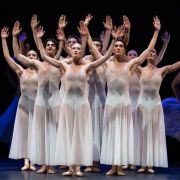
First up on the program was The Chairman Dances, choreographed by Ted Brandsen, the company’s Artistic Director. The music by John Adams (taken from Nixon in China) was pulsating and exciting. I liked the unisex costumes: both men and women wore the long, Serenade-like floor-length dresses. It was pleasant and I appreciated the quotes of Serenade. At one point, everyone stands with arms outstretched and palms facing an invisible light, the same as the iconic opening pose of Serenade.

Brief pause, and it’s Wubkje Kuindersma’s Two and Only. The composer of the music (Michael Benjamin) is also playing the guitar and piano onstage. Benjamin is a wonderful composer and his music had a folksy, soothing quality. The actual duet for two men (Timothy van Poucke and Conor Walmsley) was pretty, if predictable. It had a lot of mirror dancing, rolling on the floor, sideways lifts. The two dancers were gorgeous. Long, sculpted lines.

Next on the program was the one piece that most people in the audience are familiar with: Jerome Robbins’ Other Dances. This was originally set on two Soviet defectors (Natalia Makarova and Mikhail Baryshnikov). Olga Smirnova and Jacopo Tissi were also stars of the Bolshoi Ballet who defected to the Netherlands after Russia’s invasion of Ukraine. And both are exceptional dancers. When Tissi and Smirnova walk out onstage together, their lines and placement are so gorgeous that they both look like they were created in a lab to dance. Smirnova’s use of her neck, hands and back are mesmerizing.
Unfortunately, the music was played at a glacial pace. Robbins’ folksy vigor was replaced with tempi more fitting for Swan Lake’s White Swan Pas de Deux. This took away from Robbins’ trademark illusion of spontaneity. There was no acceleration in the variations: Chopin’s little fast flourishes were almost completely deleted. Also, the degree of calculated control both Smirnova and Tissi display was beautiful, but there was no playfulness or banter between them.

After intermission, the final two works on the program. Alexei Ratmansky’s Trio Kagel is a fun-but-slight work, a brief trio set to accordion music by Mauricio Kagel (thus the title). The vibe seems to be a nightclub, and two women try to compete for the affections of a man. They eventually stop competing and dance with each other. Cute. The two women (Lore Zonderman and Kira Hilli) were absolutely adorable and really got Ratmansky’s humor.

The final piece on the program was Hans van Manen’s Frank Bridge Variations. This ballet has the advantage of being set to a beautiful piece of music (Benjamin Britten’s Variations on a Theme of Frank Bridge). I appreciated the austere atmosphere van Manen was aiming at: the earth toned unitards, the dark lighting, the random configurations of dancers onstage. They all seemed to be vaguely unaware of each others’ presence, and dancing in a trance. But the relentlessly dark, somber mood became ponderous. It was an odd closer for a program. Floor Eimers and Constantine Allen were very impressive in their duet and made beautiful shapes.
The audience response was muted. This is a wonderful company with a wonderful repertoire (as evidenced by Program B), but the selected ballets of opening night did little to showcase their talents.