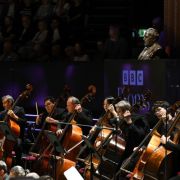


The 21-year-old Ukrainian violinist Bohdan Luts won the 2026 International Henryk Wieniawski Competition on 22nd October, at the end of a fortnight which brought 50 violinists to the Polish city of Poznań. They were competing for a €60,000 top prize, but also the potential launch of a career – and a place in history. Jinzhu Li (18, from China) won the €30,000 second prize and SooBeen Lee (26, South Korea) took the €15,000 third prize.

A daily competition newspaper, assembled and published at astonishing speed by its staff, contained interviews with recent prize-winners such as Bomsori Kim, essays on the featured compositions, and overnight critiques of the performances in the previous concert. These last were written by members of the contingent of Polish journalists who had descended on Poznań for the event, and they did not hold back. One of them went so far as to say that the announcement of the 12 third-round candidates “buried most of my hopes for an interesting continuation”.
This critic was not alone in lamenting the elimination of Teofil Milenković, among others, whose centred tone and refined phrasing in Chausson’s Poème had captivated the second-round audience. Playing judge and jury is part of the fun of attending competitions, and I have a deplorable track record in aligning my own impressions and verdicts with those collective decisions which actually matter.
On this occasion, for what it’s worth, I felt that justice had been served: we had three deserving finalists and an outstanding winner who demonstrated the maturity needed to prove worthy of his accolade over the years to come. With Ginette Neveu as the competition’s first winner back in 1935 (when David Oistrakh came second), Luts is joining violin royalty.
All the same, to publish such candid reviews and reactions indicates a persuasive internal confidence in the value and integrity of the Wieniawski Competition. Five days in Poznań left on me the impression of an event and an organisation that does so much more than push another well-bred hamster on to the wheel of international touring, bow in one paw, Strad in the other. Rather, those of us present took part in a celebration of Polish violin culture, in music from Wieniawski to (almost) our own time; also a celebration of virtuosity and musicianship from the young contestants in an enthusiastically supported, non-adversarial environment which encouraged them to give of their best and to learn from the experience.


As director of the competition, Karolina Kaźmierczak has led an overhaul of the repertoire which cuts out evergreens such as Brahms from the second, sonata-focused round because, as she explained at a press-conference before the semi-finals, at least half the candidates would likely settle for such a safe choice. Tchaikovsky was also notable by his absence from the concerto semi-finals.

Instead, Polish composers featured largely, and then exclusively, in a new third round where the 12 remaining competitors (whittled down from 50 initial finalists) were invited to select one of four concertante pieces by Górecki, Panufnik, Penderecki and Weinberg, accompanied by the strings of the Amadeus Chamber Orchestra of Polish Radio under the assured baton of Anna Duczmal-Mróz. This innovation served to promote first-rate pieces such as the concertos of Panufnik and Weinberg, under-appreciated even in their composers’ home country.
More saliently, the competition’s third round sorted the sheep from the goats in terms of their capacity to learn and present 20th-century music likely unknown to them otherwise, and to work with an ensemble in doing so rather than unboxing a well-honed, ready-made interpretation. To take one instance: a gulf of idiom separated Ruifeng Lin’s prosaic Panufnik, notwithstanding the glamorous projection that won him first prize at the inaugural Bogotá International Violin Competition in 2025, from the inward spirit and rhythmic fluidity of Luts’s account.
Probably the best-placed person in the hall – and perhaps anywhere else – to appreciate finer distinctions in these performances was the juror Alexander Sitkovetsky. “I grew up with the Panufnik Concerto,” he told me after the press conference. “I began playing it at the age of 15, I rehearsed it with Menuhin [the first performer] shortly before his death, and I have recorded it twice” – the second version with Lukas Borowicz, conductor of the Poznań Philharmonic Orchestra, for the semi-finals and final.
Sitkovetsky has never served on the jury of a major competition. “I took a lot of convincing! But my great-uncle Julian Sitkovetsky won second prize in the 1952 Wieniawski Competition. And I spend a lot of time here now in Poland, as artistic director of the NFM Leopoldinum Orchestra in Wrocław. I love the music of Wieniawski, and it brings back happy childhood memories.”
As an experienced teacher but with a fresh perspective on competitions, what is Sitkovetsky looking and listening for? “At the end of the day, one should follow the score and the composer’s intentions, but it’s up to the individual how much of themselves they want to put in. We heard a huge variety of idiomatic approaches to Romantic-era music in the first two rounds. We’re not in a position to discuss between ourselves, but I think no one’s interested in a specific prototype of playing – we want to hear the most convincing performance, and that doesn’t have so much to do with the particular approach and style.”

As Sitkovetsky observes, these are young competitors, and they may not have found “their” voice yet: it develops over time. “Even if you don’t have a clear voice, you can have so much to say about a piece. I used to have a teacher who told me – if you are convincing enough, you can play with your legs, I don’t care. But it’s the Wieniawski Competition, and so we want to hear them play this music with a feel and an understanding for the culture around him: the salon charm, the virtuosity. With rubato – you can steal time in different ways, right? Just as when pianists play Chopin.”
Sitting at their tables, halfway back in the University Aula in Poznań, the 10-strong jury presented their own broad spectrum of ages, nationalities and dedicated pursuits within the violin world. “We want as many points of view as possible,” remarked the chair, Bartłomiej Nizioł, at the press conference. “We’re not looking for a singular vision of a perfect performer.” Still, what united most of them was experience at the sharp end of major competitions, including the Wieniawski itself, where both Nizioł and his fellow Polish juror Agata Szymczewska won first prize, in 1991 and 2006 respectively.


Meng Zhou opened the concerto semi-finals with an account of the Sibelius majoring on strong line over dynamic sensitivity. Jooha Choi followed suit in the Brahms, at least until a delightfully sprung finale. Visibly pale and unsettled when she came on stage, Anna Im gave a gripping account of the Brahms quite outside the usual run of competition performances in terms of its expressive commitment. Indeed this may be one factor in her failure to reach the final, along with a few rocky moments in the first movement when it appeared that the occasion had got the better of her, though it transpired that she was suffering from a heavy cold.
In the second semi-final, SooBeen Lee brought piercing sweetness to the opening phrase of the Sibelius, and coloured the Paganinian fireworks of the first movement with imaginative variations of vibrato and pure tone. Most technically scrupulous of all the semi-finalists, Jinzhu Li also dovetailed with the orchestra more neatly, and her Sibelius suffered only from a want of vulnerable expression, and a broader awareness of how the Concerto fits in the composer’s output between the romantic nationalism of the Second Symphony and the distilled classicism of the Third.
That left Bohdan Luts, who shrewdly drew on his experience of recording the Dvořák Concerto (for Orchid Classics, in 2024) by telling a story with each phrase. As in his Panufnik, he took every opportunity to play quietly, and leant into the folk character of the outer movements with understated good taste.
As the finalists, Lee, Li and Luts were left with a binary choice: either the First Concerto which the 17-year-old Wieniawski composed as a vehicle for the prodigious virtuosity that made his name across Europe as the pre-eminent successor to Paganini; or the still formidable technical challenges posed by the later and more melodically attractive Second. Only once has the Competition been won by a contestant with the First, and SooBeen Lee and Jinzhu Li found themselves on the wrong side of history.
Playing for much of the time with her eyes shut, perhaps understandably focused on the ferocious difficulties of the solo part, Lee did not make life easy for the orchestra. Li won a rapturous reception from the audience at the University Aula; the purity of her double-stopping and her smoothly repeatable bow action are magnetising in themselves, while inspiring confidence that she has the measure of everything under her fingers.

With disarming frankness, Luts had confessed beforehand that his choice of the Second Concerto was at least partially motivated by the (slightly) lower bar of its technical demands. However, what distinguished him as the worthy first-prize winner was an imagination transcending the notes on the page, as well as the most alert sensitivity (of all competitors) to the orchestra and conductor. Physically and musically, he listened to them and responded accordingly. He makes no great show on the stage, but his playing has a charm as well as the kind of conviction and intelligence that should support him whatever the future holds.
“It may well be that the first prize-winner doesn’t go on to have the biggest career,” remarked Bartek Nizioł in the press conference. “We’re trying to find the best of the best, not the survival of the fittest.” In that and much else, the 2026 Wienawski Competition can be counted an unqualified success.
Watch all stages from the 2026 International Henryk Wieniawski Violin Competition.
See upcoming performances by Bohdan Luts.
This article was sponsored by the International Henryk Wieniawski Violin Competition.